Answer: Assess an AI-fluent software engineer by watching how they frame a problem, supply context, verify generated output, debug failures, protect system boundaries, and take responsibility for the final result. Let candidates use the tools they would use at work, but score the engineering judgment around those tools—not the amount of code generated or the fluency of a prompt demonstration.
TL;DR
- Define what AI fluency means for the actual role before screening candidates.
- Treat AI keywords, certificates, and tool names as discovery signals—not proof of production ability.
- Use an AI-allowed, role-relevant work sample with realistic ambiguity and constraints.
- Observe what the candidate accepts, rejects, tests, measures, and escalates.
- Score problem framing, verification, debugging, architecture, security, and ownership separately.
- Keep the final interview and hiring decision with accountable people.
AI fluency is becoming common—and harder to evaluate
AI use is no longer a rare differentiator among software engineers. GitHub reported that more than 1.1 million public repositories imported an LLM SDK in 2025, up 178% year over year. Lightcast's August 2026 analysis also found that employers hiring people to build AI still ask for broad foundations such as programming, Python, computer science, data science, communication, and leadership.
That creates a hiring problem. A candidate can honestly list AI tools without showing whether they can use them safely and effectively in production.
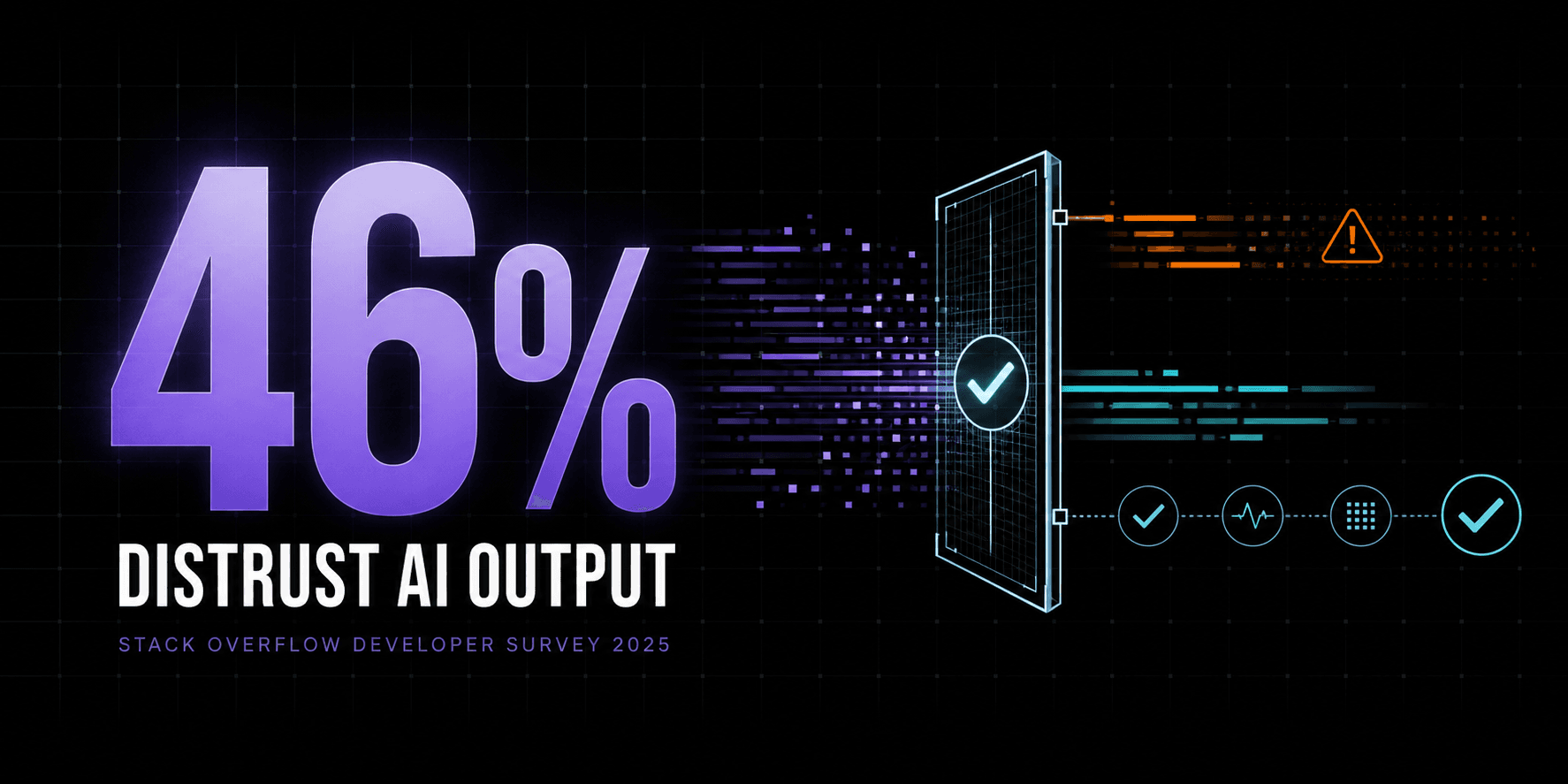
The same gap appears in developer sentiment. In Stack Overflow's 2025 survey, 46% of respondents to the accuracy question distrusted AI output, compared with 33% who trusted it. The most commonly reported frustration was a solution that was almost right but not quite; 45% also reported that debugging AI-generated code could take more time.
The useful hiring question is therefore not:
Does this engineer use AI?
It is:
Can this engineer use AI while preserving understanding, verification, and ownership of the system?
Start by defining the AI boundary of the role
“AI-fluent engineer” can describe very different jobs. Before evaluating candidates, define which of these situations applies.
| Role context | What AI fluency may require | What should not be assumed |
|---|
| Product engineer using coding assistants | task decomposition, context selection, tests, review, debugging | ability to design an AI product |
| Engineer integrating model APIs | evaluation, failure handling, data boundaries, latency and cost trade-offs | deep model-training expertise |
| AI application engineer | retrieval, tool use, evaluation datasets, observability, fallback design | research-level ML knowledge |
| ML or model engineer | data quality, experimentation, training, inference, statistical reasoning | product and systems ownership in every environment |
| Engineering lead in an AI-heavy team | review standards, architecture, risk decisions, team workflows | highest personal code-generation speed |
A role brief should specify the outcome, the AI-related decisions the engineer will own, the systems they will touch, and the failures that matter. This prevents a fashionable tool name from becoming a substitute for job analysis.
Use a six-part evidence rubric
The rubric below works across many software roles, but the examples and scoring anchors should be adapted to the project.
1. Problem framing
Strong AI-assisted work begins before a prompt is written. Look for whether the candidate can:
- identify the actual user or system outcome;
- separate known requirements from assumptions;
- locate missing context;
- divide the problem into testable parts;
- recognize when the task is too ambiguous or risky to delegate.
A weak signal is a candidate who immediately generates code from an incomplete request. A stronger signal is a candidate who first narrows the problem and explains which decisions require human confirmation.
2. Context management
AI tools perform differently depending on the context they receive. Ask how the candidate decides what to provide and what to withhold.
Useful evidence includes:
- selecting relevant files, interfaces, logs, and documentation;
- preserving repository conventions and architectural constraints;
- avoiding unnecessary exposure of credentials or private data;
- checking whether retrieved context is current;
- keeping the task small enough to review meaningfully.
The goal is not the longest prompt. It is sufficient, relevant, and safe context.
3. Verification
An AI-fluent engineer needs a concrete definition of “correct.” Depending on the role, verification may include:
- unit, integration, and regression tests;
- type checking and static analysis;
- comparison against an API contract or acceptance criteria;
- evaluation datasets for model behavior;
- security and privacy checks;
- performance, latency, or cost measurements;
- manual inspection of high-risk behavior.
Ask what evidence would make the candidate comfortable merging or shipping the change. “The answer looks right” is not a verification strategy.
4. Debugging and failure analysis
AI-generated code often fails plausibly. It may compile while misunderstanding a boundary condition, use a nonexistent API, weaken an authorization check, or solve the visible symptom instead of the underlying issue.
Look for a candidate who can:
- reproduce a failure before changing code;
- isolate whether the problem comes from requirements, context, generation, integration, or the existing system;
- inspect logs and traces rather than repeatedly prompting;
- reject a confident but unsupported suggestion;
- add a regression test after finding the cause.
The important signal is not whether the model makes a mistake. Models will. The signal is whether the engineer notices, explains, and contains it.
5. System judgment
Local code quality is only part of production engineering. The candidate should consider how an AI-assisted change affects the wider system:
- data ownership and migration;
- authentication and authorization;
- backward compatibility;
- observability and rollback;
- operational cost and latency;
- failure isolation;
- maintainability by the rest of the team.
This is where seniority often becomes visible. A generated implementation may be technically valid while still being the wrong change for the system.
6. Ownership and communication
The candidate—not the tool—owns the final decision. Useful evidence includes the ability to:
- explain the change without hiding behind generated text;
- distinguish personal reasoning from AI suggestions;
- document unresolved risks;
- ask for review when the impact exceeds their confidence;
- respond constructively when evidence contradicts the first solution;
- leave the code understandable to another engineer.
PwC's 2026 AI Jobs Barometer found that skill requirements in highly AI-exposed jobs were changing more than twice as fast as in less-exposed jobs, while judgment, creativity, and leadership became more prominent. Tool knowledge will continue to change. Ownership travels across tools.
Run an AI-allowed work sample
Banning AI can make an assessment less representative of the job. Allowing unrestricted generation without observing the process can make it meaningless. A better exercise makes tool use visible and keeps the task tied to real work.
A practical format
Give the candidate a small repository or realistic system extract containing:
- an incomplete but understandable requirement;
- one relevant architectural constraint;
- a failing test or production-like symptom;
- at least one plausible but incorrect path;
- clear rules about data, external services, and time.
Allow the candidate to use their normal AI coding tool. Ask them to share their reasoning, not every keystroke. The expected output should include:
- a short problem statement and assumptions;
- a proposed plan;
- the implementation or diagnosis;
- verification evidence;
- known gaps, risks, and follow-up work.
The exercise should be proportionate to the role and short enough to respect candidate time. If substantial work is required, compensation and clear reuse boundaries should be considered.
What to observe
Do not score prompt elegance. Observe the engineering decisions around the tool:
- Did the candidate clarify the requirement?
- Did they inspect the existing system before generating a change?
- What output did they reject, and why?
- Did they test behavior beyond the happy path?
- Could they explain the final code without the model?
- Did they identify security, data, or operational risks?
- Did they know when to stop and ask for review?
METR's early-2025 randomized study illustrates why context matters. Sixteen experienced open-source developers completed 246 tasks in repositories they knew well; with the then-current AI tools, the measured tasks took 19% longer on average. In February 2026, METR said a follow-up using newer tools could not produce a reliable speedup estimate because of selection and measurement problems, although the researchers believed tools had likely improved. The responsible conclusion is not that AI always slows or speeds engineers. It is that productivity depends on the developer, tool, task, repository, and measurement method.
Add structured interview questions
Use the same core questions and scoring anchors for candidates in the same role, then ask focused follow-ups based on their evidence. The U.S. Office of Personnel Management describes structured interviews as job-related questions evaluated with common standards; this makes comparisons more consistent than an unstructured conversation.
Useful questions include:
- Tell us about an AI-generated suggestion you rejected. What evidence made it unsafe or incorrect?
- How do you decide which repository context an AI tool needs for a change?
- Describe a bug that looked correct at first. How did you isolate the cause?
- What must be true before you merge AI-assisted code?
- How would you evaluate a model-backed feature whose answers cannot be captured by one deterministic test?
- Which data would you never provide to an external model, and how would you enforce that boundary?
- When does AI make a task slower or riskier for you?
- How do you review a large generated change that is locally correct but architecturally unfamiliar?
For each question, define in advance what weak, acceptable, and strong evidence looks like for the role.
Score evidence, not confidence
A simple four-level scale can make the decision easier to explain:
| Level | Evidence pattern |
|---|
| 0 — Not demonstrated | gives opinions or tool names without a relevant example |
| 1 — Assisted | can use the tool but relies on output appearance or external review for correctness |
| 2 — Independent | frames, verifies, debugs, and explains AI-assisted work within familiar scope |
| 3 — Leads | designs team-level controls, evaluation methods, and system boundaries; teaches others and handles unfamiliar risk |
Score each dimension separately. A candidate may be strong at AI application evaluation and weaker at infrastructure operations, or excellent at backend ownership while still learning agent frameworks. That profile can still be a good fit when it matches the work.
Avoid collapsing the result into an unexplained universal score. A useful recommendation shows:
- what the candidate demonstrated;
- which evidence supports the assessment;
- what remains inferred;
- which gaps matter for this role;
- what the next interview should verify.
What not to use as proof
These signals can help find candidates, but none should decide the interview on its own:
- listing ChatGPT, Copilot, Claude, Codex, or an agent framework;
- an AI certificate or course badge;
- a polished prompt demonstration;
- the number of generated lines or commits;
- a public repository without understanding authorship and context;
- a self-reported productivity multiplier;
- one benchmark score detached from the production environment.
An Oxford Internet Institute hiring experiment found that AI skills listed on synthetic resumes increased interview invitations across several occupations, including software engineering. That demonstrates the visibility value of an AI signal, not production capability or future job performance. Discovery and verification are different stages.
Where an AI hiring agent helps
An AI hiring agent can apply a role-specific rubric across candidate evidence before the hiring manager spends interview time. For an AI-fluent engineering role, that can mean:
- turning the project into explicit evaluation criteria;
- finding engineers with relevant implementation evidence;
- separating confirmed facts from inference;
- identifying missing verification;
- comparing candidates across the same dimensions;
- preparing focused questions for human interviews.
WorkorAI is an AI hiring agent for software engineers. It organizes evidence, gaps, and risks to support the decision; it does not replace the hiring manager or technical interviewer.
FAQ
What does AI-fluent mean for a software engineer?
It means the engineer can use AI tools while retaining control of problem definition, context, verification, debugging, security, and the final technical decision. The required depth depends on whether the person uses AI to write code, integrates model APIs, or builds AI systems.
Should candidates be allowed to use AI during coding interviews?
If AI use is part of the job, an AI-allowed exercise can produce more relevant evidence. The assessment should make the process observable and score reasoning, verification, and ownership rather than raw output speed.
Is prompt engineering a useful hiring signal?
It can be one operational skill, but prompt quality alone does not demonstrate software design, debugging, evaluation, security, or production ownership.
How do you verify AI engineering skills without a long take-home test?
Use existing project evidence, a short role-relevant work sample, and structured questions about real decisions. Focus the exercise on the most important uncertainty instead of recreating an entire project.
Can AI evaluate AI-fluent engineers automatically?
AI can organize evidence and make an explainable recommendation. A person should review the criteria, evidence, uncertainty, and assessment outcome before deciding whom to interview or hire.
The strongest signal is responsible ownership
AI tools will change faster than most hiring processes. The durable question is whether an engineer can turn those tools into reliable work without outsourcing judgment.
Define the role, allow realistic tool use, observe the decisions around the output, and record what the evidence does and does not prove. That produces a more useful interview decision than rewarding candidates for knowing the newest product name.
Tell WorkorAI what the engineer will build. Review the evidence, gaps, and risks before deciding whom to interview.
Describe who you need
Sources
QA: Market statistics are attributed to their source populations and do not imply that AI usage predicts individual job performance. This article is an assessment framework, not legal advice.