
hiringairecruitment+2
Why CTOs choose an evidence-backed shortlist
Improve engineering hiring with an evidence-backed shortlist: candidate ranking with verified strengths, gaps, risks, and interview rationale.
Aug 31, 20267 min read

WorkorAI Team
Your team can see a bad interview. It appears on the calendar, consumes an engineer's time and ends with a clear rejection. You cannot see the capable candidate whom the first screen removed. That person leaves no failed interview and no note in the debrief. Their absence looks like an efficient process.
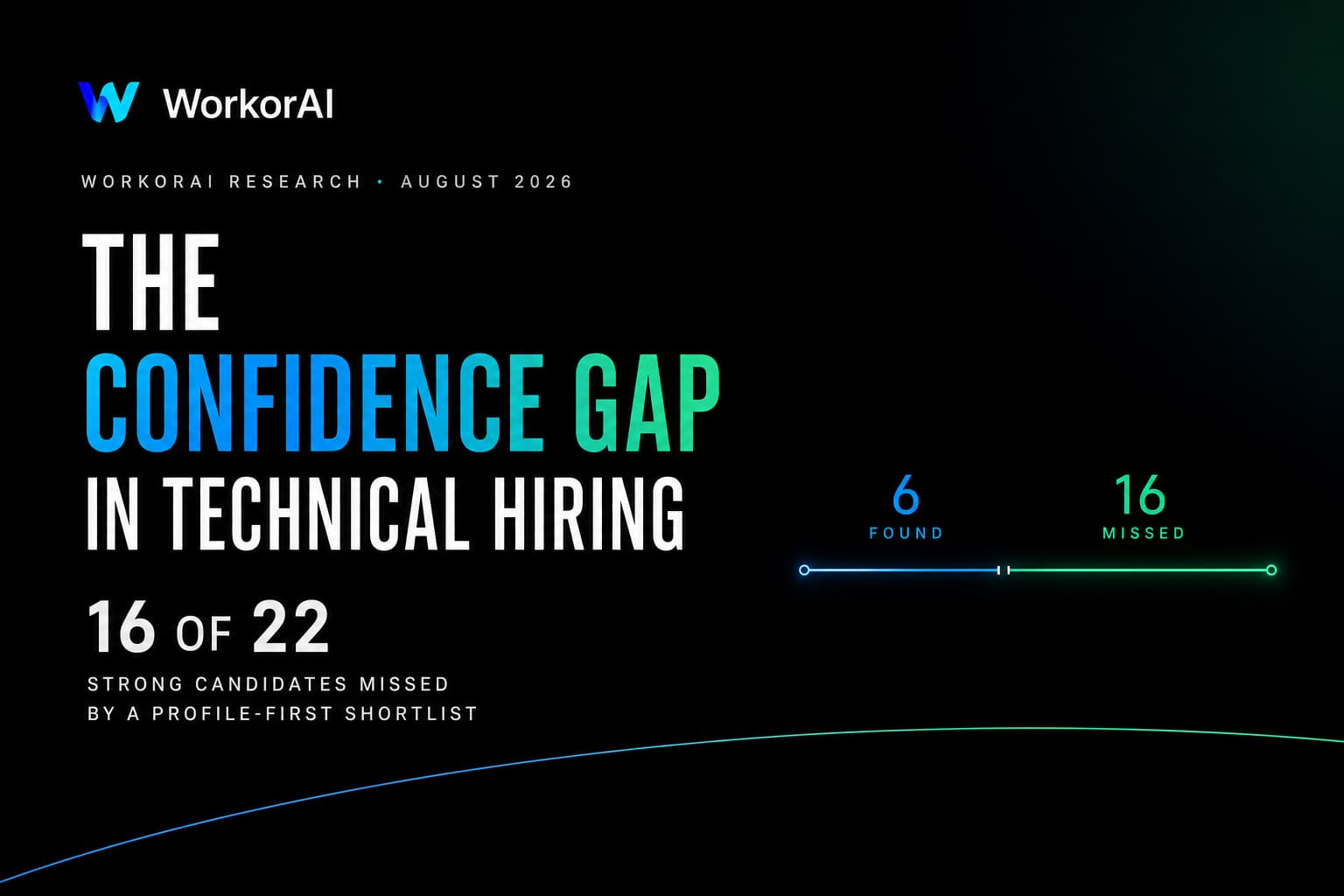
WorkorAI found this hidden error in a small internal study. We built a profile-first shortlist from years of experience, LinkedIn data, seniority, listed skills and keyword coverage. Among 22 candidate-role observations that reached our selected technical evidence threshold, the shortlist surfaced 6 and left out 16.
Those figures do not prove that an ATS rejected qualified engineers. We tested our own simulation, and our threshold does not predict job performance. The result gives hiring teams a reason to inspect who disappears before the interview stage.
You can perform that check without interviewing a hundred applicants. Give candidates with plausible experience and an imperfect profile a short route to provide job-related evidence before the final rejection.
WorkorAI analyzed a production data snapshot dated August 27, 2026. The full dataset contained 333 interview records for 285 candidates. The comparison in this article used 58 candidate-role observations with enough profile, job and completed-interview data for the same analysis.
We built the simulated shortlist from five fields that hiring teams can scan with little effort: years of experience, LinkedIn profile score, current seniority, number of listed skills and coverage of must-have keywords. We ranked candidates within each role and placed the top quarter on the shortlist.
We then compared those choices with a threshold of 70 in WorkorAI's structured technical interview. A candidate who reached 70 had provided enough relevant answers and technical detail to cross an internal evidence line. We have not linked that line to offers, hires, retention or performance at work. A score below 70 also does not establish that someone lacks the ability to do the job.
| Result | Candidate-role observations | Reading |
|---|---|---|
| Reached the evidence threshold | 22 | The interview contained enough technical evidence to cross the selected internal line |
| Shortlisted and reached the threshold | 6 | The profile-first screen surfaced the observation |
| Left out and reached the threshold | 16 | The screen missed the observation |
| Shortlisted and below the threshold | 9 | The profile looked strong; the interview did not provide enough evidence to reach the line |
The screen surfaced 6 of the 22 observations that reached the evidence threshold. It left out 16. For each one it surfaced, more than two remained outside the shortlist.
The selected group showed little improvement over the starting group. Across all 58 observations, 37.9% reached the threshold. Among the 15 on the shortlist, 40% reached it. The shortlist raised the share by 2.1 percentage points in this sample.
We did not test Greenhouse, Lever, LinkedIn Recruiter or another commercial product. Employers configure those systems in different ways. Our finding has a narrow scope: these familiar profile fields gave us weak grounds for excluding the rest of the group.
An engineer writes a profile for many readers. A recruiter wants recognizable skills. A former colleague looks for shared history. A founder may want proof that the person can handle one particular production problem. The same page cannot answer each question with equal depth.
Four profile features can hide relevant work.
One company calls an engineer “Software Engineer II.” Another company gives the same scope a Senior Engineer title. A startup employee may own architecture and incidents without receiving a formal promotion. A ranking that reads seniority from the title inherits the naming habits of the previous employer.
The hiring team needs the scope behind the title: decisions the candidate owned, systems they operated and problems they handled without supervision.
A job description asks for event-driven architecture. A candidate writes about queues, asynchronous workflows and idempotent consumers. A literal screen records a missing phrase. An engineer may recognize related experience and ask for details.
Product language creates the same gap. “Multi-tenant SaaS” and “shared platform with tenant isolation” can describe similar work. Exact wording helps search a large pool, but it gives a poor reason for rejection when adjacent experience would transfer.
Many experienced engineers build employer-owned systems. Their most relevant code may sit in private repositories that they cannot share. GitHub's profile contribution documentation lists the conditions for activity to appear on a contribution graph and withholds details of private contributions.
A quiet profile may reflect private work, another source-control system or a decision to keep work and personal identity apart. The graph cannot establish how much engineering work the candidate has done.
Some candidates list each technology they have touched. Others name the few tools they know well. Some explain their work in the language used by recruiters. Others write for engineers in their own field.
The polished profile deserves attention as a communication sample. It does not deserve control over the assessment of production ownership or technical judgment.
An unusual profile does not establish candidate strength. It creates unanswered questions. A useful screen keeps those questions separate from facts that support rejection.
Application volume has grown while recruiting capacity has fallen. Greenhouse analyzed more than 640 million applications across over 6,000 companies for its 2026 hiring benchmarks. Average applications per job rose from 116 in 2022 to 244 in 2025. Average recruiters per organization fell from 10.43 to 4.62 during the same period. The dataset covers hiring across roles, rather than software engineering alone.
A team facing 244 applications needs filters. Years, titles and keywords arrive in a format that software can compare at low cost. Production decisions and technical judgment take more effort to examine.
Cheap fields create the error when they make the rejection. Search criteria help you locate plausible people. A rejection requires enough information to conclude that further review has low value. Profile-first screening can treat those two decisions as one.
You can separate them with a small evidence check between discovery and the final shortlist.
Candidates with direct, well-documented experience can enter through the normal profile route. Candidates with relevant clues and an important gap can enter through an evidence route. Both routes lead to the same standard for the role.
Consider a backend job that requires experience with queue-based systems. A candidate has no “event-driven architecture” keyword, but their profile mentions payment workflows and background processing.
The screen can reject the missing phrase, or the team can ask two questions:
The answers may expose shallow involvement. They may show direct experience under different language. Either result gives the hiring team information tied to the work.
An evidence check should take less effort than a team interview. It may use a short written response, a focused conversation or relevant code when the candidate can share it. The method should fit the role and the candidate's circumstances.
Avoid turning the evidence route into unpaid project work. A large take-home task creates a new participation filter and asks candidates to absorb the cost of weak screening. Ask for the smallest piece of information that can resolve the profile gap.
The hiring brief determines whether the evidence route asks useful questions. “Senior backend engineer with seven years of Python” directs attention toward labels and duration. A work-based brief names the decisions the new hire will face.
For a small SaaS team, the brief might include ownership of customer-facing APIs, reliability work as usage grows, production debugging and data-model choices under changing requirements. Each item gives a candidate a concrete way to demonstrate relevant experience.
The team can then sort screening criteria into two groups.
Hard constraints make the working relationship impossible when they do not align. The group may include legal work authorization, required working-hour overlap or a compensation ceiling. Hiring teams should confirm these points with the candidate instead of inferring them from a location or title.
Profile clues help find people but require interpretation. The group may include years of experience, an exact title, named technologies or public code. A gap in one of these fields should trigger a question when the rest of the profile suggests relevant work.
This distinction protects the standard. The team does not waive a requirement. It stops promoting convenient clues into requirements without examining the role.
Screening systems tend to force each field toward a positive or negative result. Hiring evidence contains a third state: unknown.
Suppose a candidate claims they “led a migration to PostgreSQL.” The sentence supports a claim about participation. It does not establish the design decisions they owned, the scale involved or the result.
A useful candidate record would say:
| Requirement | Current evidence | Status | Next check |
|---|---|---|---|
| Own data-model decisions | Candidate reports leading a PostgreSQL migration | Partial | Ask which schema and migration decisions belonged to them |
| Handle production risk | No incident example in the profile | Unknown | Ask about rollback, data integrity and failure handling |
| Work in a small team | Employment history shows a 12-person company | Partial | Confirm team size and personal scope |
“Unknown” prevents the system from inventing confidence. It also prevents an absent detail from becoming an automatic rejection.
The hiring manager can see the basis for each judgment and decide whether the missing evidence deserves another question. A match percentage hides that distinction.
Profile-first interviews can follow the shape of the resume. One candidate gets questions about architecture because the profile mentions architecture. Another gets implementation questions because the profile lists tools. The interviewer then compares answers to different tests.
Candidates for the same job need a comparable chance to demonstrate the capabilities in the brief. The interviewer can ask follow-up questions, but the core areas and evaluation standard should remain consistent.
The U.S. Office of Personnel Management recommends job-related questions and consistent evaluation standards in its structured interview guidance. Sackett and colleagues placed structured interviews at the top of their revised ranking in a 2022 meta-analysis of personnel selection methods.
Neither source validates WorkorAI's interview or guarantees that an interview will predict performance. They support the use of job-related questions and comparable evaluation when employers choose whom to advance.
A team can test its screen before changing the live process. Choose one role and keep the existing shortlist. Build a second list from the work-based brief, a short evidence check and a record of missing information.
Compare the two lists before showing names, titles or employer brands to the reviewer. Record four results:
Review the third group with care. Note which profile gap caused the first screen to remove each person. Follow the candidates who enter human interviews and record the interviewer's decision. Repeat the comparison across roles before changing the standard.
This audit can also expose a cost on the candidate side. In the WorkorAI snapshot, Senior-level candidates completed the interview flow at a rate of 39.4%, compared with 62.6% for candidates below Senior level, among people with an interview record and usable LinkedIn data. A long evidence step, or one sent at a bad time, may exclude the experienced people you hoped to recover.
Keep the check focused. Tell candidates why you ask each question. Track completion as well as assessment results.
An evidence route will not fill the shortlist with hidden stars. It gives the team a way to correct some profile errors before they become rejections.
The hiring manager receives a reason for each recommendation, the source behind that reason and a list of points that need an interview. Engineers can spend their interview time on those open questions instead of repeating a resume walkthrough.
The process also makes disagreement useful. A CTO can challenge the evidence, change the role requirement or ask for another check. An unexplained score offers none of those options.
Read The confidence gap in technical hiring for the broader analysis of repeated profile signals. Our guide to a decision-ready software engineering shortlist shows how to present evidence, gaps and interview questions for each recommendation.
The study supports a testable concern, not a market-wide rejection rate.
The result applies to this sample and this simulation: familiar profile fields left out many candidate-role observations that reached the selected evidence threshold.
Choose a software engineering role. Keep your present screening method and build a second shortlist in parallel. Use the work the person must do, give uncertain profiles a short evidence route and label gaps as unknown.
The comparison may support your existing process. It may surface credible candidates whom the first screen removed. Either outcome gives you evidence about your own hiring funnel.
WorkorAI is building this workflow for software engineering hiring. You describe the work. WorkorAI finds relevant engineers, examines role-specific evidence and shows gaps for the hiring team to review. People conduct the interviews and make the hiring decision.
Hiring a software engineer? Describe who you need, starting with the problem they must solve.
Employers configure ATS rules and decide how to use them. This study tested a WorkorAI simulation based on common profile fields. It did not test a commercial ATS or establish a general ATS rejection rate.
A profile-first shortlist relies on easy-to-scan details such as titles, years of experience, listed skills, keyword overlap and public activity. Those details help a team find plausible candidates. They provide limited evidence about ownership, judgment and fit for one role.
The phrase refers to a candidate-role observation that reached WorkorAI's selected 70-point technical evidence threshold. It does not describe a proven hire or rank the person across all software engineering jobs.
No. A short evidence check sits before the team interview. Use it for a candidate whose profile suggests relevant work and leaves an important question unanswered.
Yes. Keywords can locate candidates with related experience. Exact wording should not decide rejection when the role allows adjacent experience.
Track which candidates each method advances, completion and withdrawal, human interview decisions, offers, hires and later performance indicators. Record the time that recruiters, hiring managers and engineers spend at each stage. These measures will show whether a cleaner shortlist improves the hiring process or conceals a different error.
This article reports exploratory WorkorAI findings from a production snapshot. We report candidate data in aggregate and use different subsets according to the available profile, job and interview data. We use the technical evidence threshold to compare observations inside this dataset; it does not express a probability of hiring success. WorkorAI needs to compare these early signals with human interview decisions, accepted introductions, offers, hires, retention and post-hire performance.
More posts
Improve engineering hiring with an evidence-backed shortlist: candidate ranking with verified strengths, gaps, risks, and interview rationale.
Why years of experience, senior titles, CV keywords and GitHub activity can make a software engineering shortlist look safer than it really is.

A practical framework for assessing AI-fluent software engineers through problem framing, verification, debugging, system judgment, and ownership—not tool names or prompt demos.