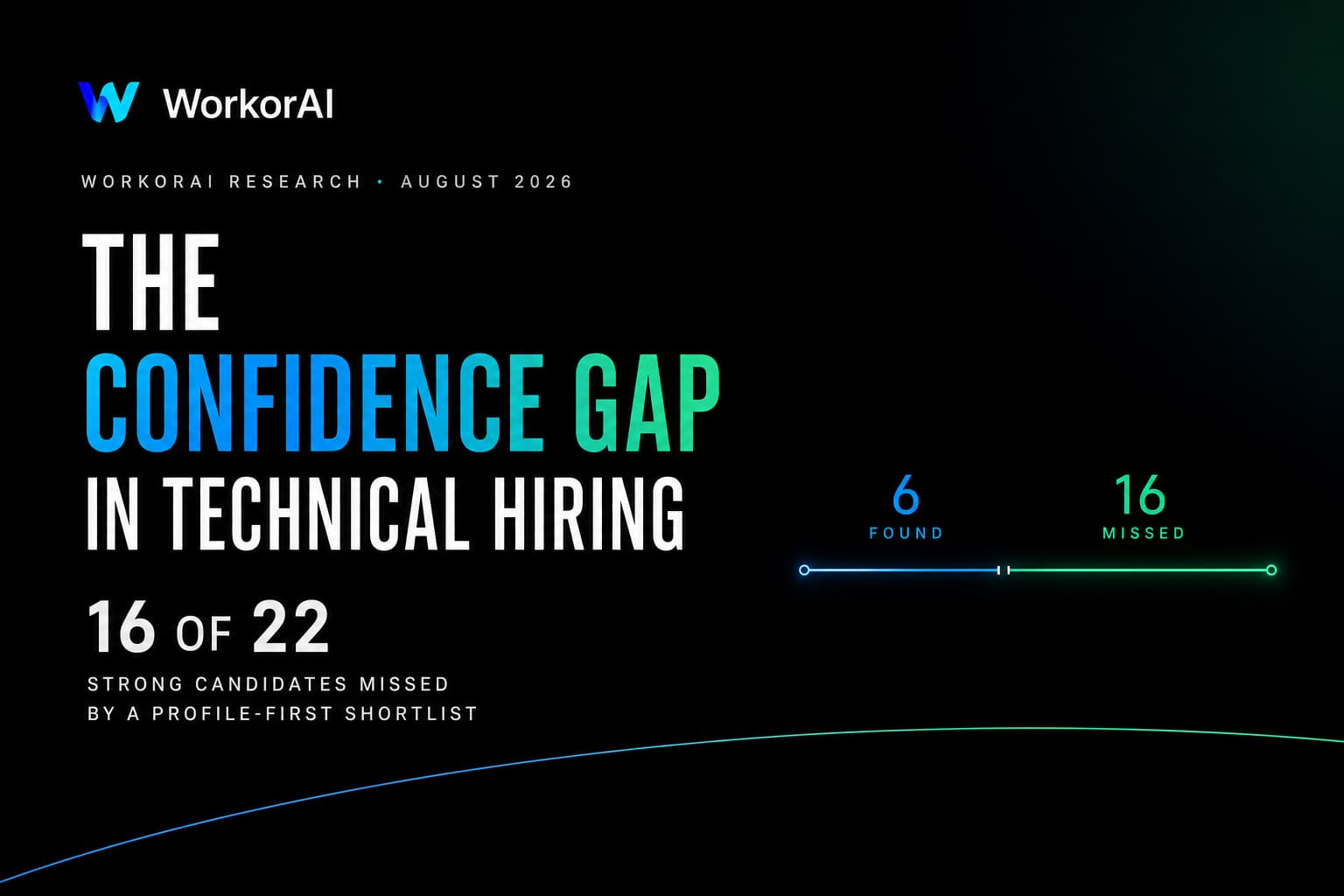
Engineering leaders rarely struggle because they have too few resumes. They struggle because too many profiles create too little clarity. In engineering hiring, volume often looks like progress right up until a CTO or Head of Engineering has to decide who actually deserves interview time. At that point, overloaded pipelines, inconsistent notes, and shallow summaries create signal loss. What leaders need is not more candidates, but an evidence-backed shortlist they can trust.
More candidates is not the same as better hiring
Many teams still treat hiring throughput as the main success metric: more sourcing, more applicants, more recruiter screens, more profiles sent downstream. But in engineering hiring, a larger pipeline often increases review burden without improving decision quality.
A list of 100 candidates can still leave a team uncertain about who is truly viable. A shortlist of five well-evaluated candidates can move the role forward faster.
This is the core mistake behind many slow or frustrating hiring processes. Teams assume optionality comes from volume, when in practice it comes from clarity. A CTO does not want a database that still needs interpretation. They want an evidence-backed shortlist that makes the next decision easier.
In many organizations, the real bottleneck is not candidate count. It is the quality of judgment applied before interview time is consumed.
What an evidence-backed shortlist actually is
An evidence-backed shortlist is not just a list of top applicants. It is a decision artifact.
Each candidate on that shortlist should include:
- verified strengths
- known gaps
- visible hiring risks
- a clear reason to interview
- explanation of role fit
- relative candidate ranking based on the actual role requirements
That distinction matters. In engineering hiring, vague endorsements create more work for technical leaders. Structured evidence reduces it.
What “evidence-backed” means in technical hiring
“Evidence-backed” does not mean perfect certainty. It means the recommendation is grounded in observable signals rather than intuition alone.
Useful evidence may include:
- demonstrated scope of technical ownership
- clear indications of architecture or system design depth
- stack or domain relevance
- progression in responsibility
- evidence of shipping and execution
- collaboration and leadership context
- constraints that affect fit, such as compensation or location expectations
This kind of structure improves candidate ranking because it surfaces tradeoffs instead of hiding them behind generic language.
Why “reason to interview” matters
A shortlist becomes more useful when it explains not only why someone is strong, but why they belong in the process now.
That rationale helps leaders answer practical questions:
- What is promising enough to justify time?
- What needs to be validated in interviews?
- Which uncertainty is acceptable at this stage?
- What makes this candidate more relevant than the next one?
Without that reasoning, engineering hiring loops often become exploratory rather than evaluative.
Why CTOs care about shortlist quality
Weak shortlists create costs that are easy to underestimate.
The first cost is engineering time. When early screening does not surface meaningful strengths, gaps, and risks, hiring managers and senior engineers spend interview time discovering basic issues that should have been visible earlier.
The second cost is process drift. Interview loops start acting as screening layers instead of decision layers. Panels are not evaluating a hypothesis; they are trying to figure out whether there was ever a good reason to interview the candidate in the first place.
The third cost is mis-ranking. A candidate may look impressive on paper but lack depth in the exact systems, environments, or leadership conditions the role requires. Another may be technically strong but carry constraints around salary, timezone overlap, or scope that make close impossible. When candidate ranking ignores those realities, teams create false positives and false negatives.
For a CTO, these are not abstract problems. They show up as:
- slower headcount conversion
- weaker trust in recruiting output
- interview fatigue among senior engineers
- poor calibration between recruiting and engineering leadership
- delivery risk when critical roles remain open
An open staff backend role, platform hire, or engineering manager position does not just sit on an org chart. It affects roadmap confidence.
The difference between a big pipeline and a useful shortlist
The contrast between quantity-driven recruiting and decision-grade hiring output is simple.
Big pipeline
A big pipeline usually means:
- many resumes
- inconsistent notes
- shallow screening
- weak candidate ranking logic
- unclear rationale for next steps
This can create the appearance of momentum while increasing uncertainty.
Useful shortlist
A useful shortlist usually means:
- fewer candidates
- verified signals
- explicit strengths and gaps
- visible risks
- interview rationale tied to hiring goals
The point is not merely to reduce volume. The point is to reduce uncertainty.
A useful shortlist should answer:
- Why this person?
- Why now?
- Under what role conditions do they fit?
- What should the interview panel validate next?
If those questions remain unanswered, the pipeline is still doing too much interpretive work at the executive layer.
What should be inside an evidence-backed shortlist
For CTOs and Heads of Engineering, shortlist quality improves when the format is consistent and decision-oriented.
Candidate summary
Start with the basics that matter for role fit:
- role alignment
- seniority fit
- domain relevance
- likely impact area
This is the minimum context needed to orient a reviewer quickly.
Verified strengths
Strengths should be specific enough to support a decision, not just create a positive impression. Examples include:
- architecture depth
- backend or frontend specialization
- infrastructure experience
- leadership signal
- shipping velocity
- stack relevance
“Strong engineer” is rarely useful. “Strong in distributed backend systems with recent ownership of reliability-sensitive services” is useful.
Gaps
Every serious candidate has gaps relative to a role. Surfacing them early improves decision quality.
Common examples:
- missing domain experience
- unclear scale exposure
- limited ownership history
- weak communication signal
- toolchain mismatch
A good evidence-backed shortlist makes these visible without automatically disqualifying the candidate.
Risks
Risks are different from gaps. A gap may be trainable. A risk may affect process efficiency or close probability.
Examples include:
- compensation mismatch
- relocation or timezone constraints
- remote preference mismatch
- unstable tenure pattern
- overqualification or under-scoping risk
This is one reason a structured shortlist often outperforms pure resume review. Many real hiring outcomes hinge on practical fit, not just technical ability.
Interview rationale
Each candidate should include a reason for entering the process and a hypothesis to test.
That rationale might cover:
- why the candidate belongs in the loop
- what the team should validate next
- which interviewer should focus on which area
This turns interviewing into a targeted evaluation exercise instead of an open-ended discovery call.
Candidate ranking logic
Good candidate ranking should explain:
- how this candidate compares with others
- what tradeoffs justify the ordering
- why the order might change depending on role priorities
That last point matters. Ranking is conditional. A candidate who ranks first for a fast-scaling platform team may rank lower for a people-heavy engineering management role.
Why verified strengths, gaps, and risks beat generic recruiter summaries
The problem with generic summaries is not that they are positive. It is that they are often too compressed to be actionable.
“Strong candidate” does not help a CTO decide.
“Strong in distributed backend systems, weaker in people management, compensation risk high” does help.
Structured judgment is more useful than optimistic adjectives. It prepares the panel better, sharpens debriefs, and reduces rework after early interviews.
This approach also improves alignment across functions. Recruiters, hiring managers, and executive reviewers can all work from the same visible reasoning rather than carrying different interpretations of the same profile.
That is especially important in engineering hiring, where one person may optimize for technical pedigree, another for delivery execution, and another for closing probability. A good shortlist makes those tradeoffs inspectable.
How better candidate ranking improves engineering hiring
Better candidate ranking changes the process in practical ways.
First, it ties evaluation to role-specific needs rather than generic employability. A candidate is not “top” in the abstract. They are stronger or weaker relative to a specific engineering context.
Second, it helps teams allocate interview time intentionally. If the top-ranked candidates are supported by visible evidence, the team can move faster with more confidence.
Third, it helps organizations know when to stop searching and start interviewing. Endless pipeline expansion is often a symptom of weak conviction, not high standards.
A useful ranking model should consider:
- must-have technical criteria
- role context
- team topology
- leadership requirements
- location and collaboration realities
- compensation boundaries
- execution risk
The key nuance is that ranking is never universal. It is conditional on the role, team, and business constraints. That is exactly why evidence matters.
A shortlist should be a decision artifact
The executive standard is straightforward: a shortlist should support a decision the moment it is reviewed.
For each candidate, a CTO or Head of Engineering should be able to quickly determine whether to:
- interview
- hold
- reject
- compare against another candidate
- revisit role expectations
This is what makes the shortlist a real decision artifact rather than an administrative output.
Good decision artifacts compress complexity into structured reasoning. They speed up conversations without oversimplifying them. They also preserve institutional memory: why a candidate advanced, why another was deprioritized, and what the panel was supposed to validate next.
A strong shortlist should answer executive questions like:
- Why is this candidate in the top tier?
- What evidence supports that view?
- What is the biggest unresolved risk?
- What should the interview panel test next?
- Is this person a better fit than the current number two candidate, and why?
If the shortlist cannot answer those questions, it is not yet doing enough work.
Where WorkorAI fits in the hiring workflow
This is where WorkorAI becomes relevant.