Answer: The biggest problem in technical hiring is not a lack of candidate information. It is mistaking repeated information for verified ability. Years of experience, a senior title, a polished resume, matching keywords and a busy GitHub profile can all make the same candidate look reassuring. But until someone checks what the engineer actually built, which decisions they owned and how that experience relates to the role, the hiring team has confidence—not evidence.
TL;DR
- Hiring teams are receiving more applications with fewer people available to review them.
- The obvious response is to rely more heavily on resume keywords, titles, years of experience, LinkedIn scores and public GitHub activity.
- In WorkorAI's exploratory analysis, those clues often agreed with one another far more than they agreed with the result of a structured technical interview.
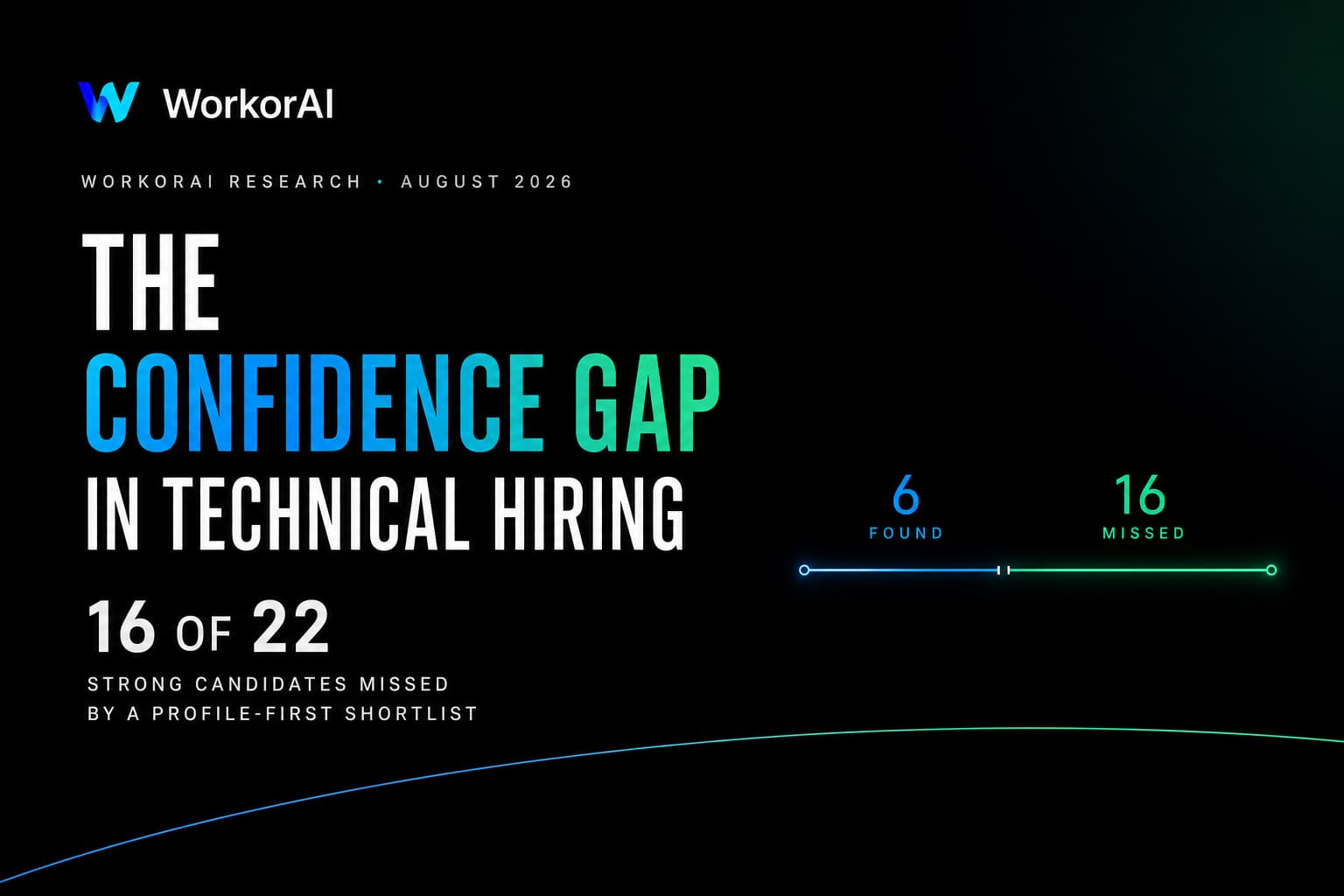
- An illustrative profile filter found only 6 of the 22 candidates who later showed strong technical evidence, while sending 9 weaker candidates into the shortlist.
- This does not mean resumes, LinkedIn, ATS tools or GitHub are useless. They are useful for finding people who may be relevant. They are much less useful as proof that someone can do a particular job.
- The practical solution is an evidence gate before expensive team interviews: check role-specific experience, decisions and technical depth; show what is supported and what remains unknown; let the hiring team make the final decision.
Imagine these two candidates
You are hiring a backend engineer for a growing SaaS product.
The first candidate has ten years of experience, a Senior Engineer title, every important keyword from the job description and a GitHub profile full of activity.
The second has five years of experience, a shorter skills list and very little public code. Most of their work was done in private company repositories.
Which person should your team interview first?
Most hiring systems will put the first candidate on top. That may be the right answer. But look closely at what has actually happened.
Ten years of experience made the candidate look senior. The senior title increased the strength of the LinkedIn profile. The same job history produced the keywords in the resume. The keywords increased the ATS match. The active GitHub account made the whole picture feel more credible.
It looks like five pieces of confirmation.
It may be only one career story, repeated in five different boxes.
Nothing in that process has yet established what the engineer personally built, how difficult the work was, which technical decisions they owned, what failed, which trade-offs they understood or whether any of that experience is useful for this particular SaaS product.
That is the confidence gap: the distance between a candidate who looks right and a candidate who has given you a good reason to spend engineering time on an interview.
Why this problem is getting more expensive
Hiring teams are not adopting shortcuts because they are careless. They are overwhelmed.
Greenhouse analyzed more than 640 million applications across over 6,000 companies. Its 2026 hiring benchmarks show that the average number of applications per job rose from 116 in 2022 to 244 in 2025—an increase of 111%. Over the same period, the average number of recruiters per organization fell from 10.43 to 4.62.
In simple terms: more candidates are entering the funnel, while fewer people are available to understand them.
LinkedIn's 2025 Future of Recruiting report, based on LinkedIn data and insights from more than 1,000 recruiting professionals, found that 72% considered improving the way candidate skills are assessed a priority for the next 12–18 months.
The market already understands the problem. The difficult part is deciding what a better assessment should look like.
The fastest filters tend to use information that is already easy to read:
- years of experience;
- current title;
- previous employers;
- skills listed in a resume or LinkedIn profile;
- exact words shared with the job description;
- public GitHub activity;
- an overall rating that summarizes the profile.
These clues are convenient. They can help find a plausible group of candidates. The mistake is allowing convenience to turn into certainty.
We compared profile confidence with technical evidence
WorkorAI examined a production data snapshot dated August 27, 2026. The complete dataset contained 333 interview records covering 285 candidates. The central analysis used 115 unique candidates who had completed an evaluated technical interview. Smaller comparisons used only the candidates who also had usable LinkedIn, GitHub or job-specific data.
The question was deliberately simple:
When the familiar profile clues become stronger, do candidates also demonstrate stronger technical evidence?
Before looking at the answer, it helps to understand what we mean by technical evidence.
We do not mean that an AI interview proves how someone will perform after being hired. It cannot. In this study, technical evidence means that a candidate could explain relevant work, decisions, technologies and trade-offs well enough to reach a selected interview threshold. That threshold helps us compare groups inside this dataset. It is not a guarantee of future job performance.
The result was not that every familiar clue failed. It was more subtle—and more important.
The profile clues agreed strongly with one another. Their relationship with the technical interview was much weaker.
The same story appeared as several scores
Consider four results from the candidates who had both completed interviews and usable LinkedIn data.
The numbers below run from zero to one. A number near one means two measurements rise and fall almost in lockstep. A number near zero means they have little relationship.
| What we compared | How closely they moved together | Plain-English reading |
|---|
| Years of experience and LinkedIn experience score | 1.00 | They were effectively the same information |
| LinkedIn experience score and overall LinkedIn score | 0.80 | Experience heavily reinforced the overall profile |
| Seniority score and overall LinkedIn score | 0.72 | The seniority label reinforced the same profile again |
| Overall LinkedIn score and technical interview result | 0.16 | A stronger LinkedIn profile told us little about the interview result |
Imagine installing five smoke alarms in an office, but connecting all five to the same sensor. When they all ring, the noise feels like overwhelming confirmation. In reality, you still have only one source of information.
That is what can happen in a hiring funnel. Years become an experience score. Experience influences seniority. Seniority influences the overall profile. Profile keywords influence the ranking. Each new number makes the recommendation look more scientific, even when little new information has been added.
Adding more fields does not automatically add more knowledge.
What happened when we simulated a familiar shortlist
To see what this could mean in practice, we built an illustrative filter from five common pieces of profile information:
- years of experience;
- overall LinkedIn profile score;
- seniority;
- number of listed skills;
- coverage of the job's must-have keywords.
We compared candidates within the same jobs, so that an engineer applying for one type of role was not unfairly compared with an engineer applying for a completely different role.
There were 58 candidate-job observations with enough information for this comparison. Twenty-two reached the selected technical-interview threshold.
The profile filter chose 15 candidates.
Here is what happened next:
| Reached the technical threshold | Did not reach it |
|---|
| Chosen by the profile filter | 6 | 9 |
| Not chosen by the profile filter | 16 | 27 |
The most important number is not the nine candidates who looked promising but did not reach the threshold. Every screening method will make mistakes.
The most important number is 16.
Sixteen of the 22 candidates who showed strong technical evidence would not have appeared in the shortlist.
The filter also created surprisingly little improvement in the group it selected. In the starting pool, 37.9% of candidates reached the threshold. Among the 15 profiles selected by the filter, the figure was 40%. The shortlist looked selective, but it was only 2.1 percentage points more likely to contain a threshold-reaching candidate than the original pool.
This is not a test of Greenhouse, LinkedIn Recruiter or any other commercial ATS. We did not reproduce the logic of a specific product. It is a small, illustrative simulation of the reasoning many teams use when several familiar profile clues point in the same direction.
The result should not be read as “ATS software does not work.” It should be read as a warning:
A shortlist can look precise without becoming much more informative.
The keyword trap is easy to see
Keywords are useful because technical roles do require specific knowledge. If you need an engineer who has worked with PostgreSQL, distributed queues and AWS, searching for those terms is a sensible way to begin.
But the presence of a word answers only one question:
Did this technology appear in the candidate's profile?
It does not answer:
- How long did they use it?
- Did they choose it or merely work near it?
- Did they operate it in production?
- What scale and constraints were involved?
- What went wrong?
- Which alternatives did they reject, and why?
- Is their experience relevant to the way your team will use it?
In 91 job-linked interviews, 34 candidates had every must-have keyword in their profile.
Only 15 of those 34 reached the selected technical threshold. Nineteen did not.
At the same time, 18 of the 33 candidates who reached the threshold did not have complete keyword coverage.
So a strict “all required keywords must be present” rule would have created both problems at once: it would have advanced people whose depth was not demonstrated and removed more than half of the people who later showed strong evidence.
The lesson is not to stop searching by skill. It is to stop treating a skill word as proof of skill depth.
A long skills list does not solve the problem
Some profiles list 20 technologies. Others list 80.
It is tempting to read the longer list as broader or stronger. In this dataset, the number of listed skills had essentially no relationship with demonstrated technical depth: the measured relationship was 0.002, as close to zero as we could reasonably expect.
This makes sense when you consider how skill lists are created. A person may include a technology they used for one project, inherited from a team, studied years ago or added because it appears in job descriptions. Another engineer may list only the tools they use deeply and regularly.
Counting the words cannot tell you the difference.
The useful follow-up is not “How many technologies do you know?” It is:
Tell me about the hardest decision you made with the technologies this role actually requires.
GitHub activity did not rescue the profile filter
Public GitHub data feels closer to real work than a resume, and sometimes it is. A relevant repository can reveal architecture, tests, documentation, review behavior and the evolution of a project.
But general activity counters are not the same as relevant engineering evidence.
Among 92 candidates with usable GitHub analysis and a completed interview, the overall GitHub score had almost no relationship with the interview result. The same was true for stars, commits and a general quality score.
Adding a general GitHub score to the profile simulation did not improve it. In the smaller group where both LinkedIn and usable GitHub data were available, the filter found an even smaller share of threshold-reaching candidates.
There is also a basic visibility problem. GitHub's own profile contribution documentation explains that contribution graphs count only activity meeting particular conditions, can omit some events and do not expose the details of private work. Many experienced engineers build employer-owned systems that can never appear in a public portfolio.
GitHub is useful when it helps answer a question about the role:
- What did this person build?
- Which part did they own?
- How did the design change over time?
- How do they handle tests, maintenance and review?
- Can they explain the choices visible in the code?
Stars and green squares cannot answer those questions by themselves.
This is not an argument against resumes or ATS tools
The wrong conclusion would be to throw away the top of the hiring funnel.
You still need an efficient way to process a large candidate pool. Resumes, LinkedIn, ATS search and GitHub can all help answer an early question:
Who might be relevant enough to examine more closely?
They are less suited to the later question:
Who has given us enough job-related evidence to deserve scarce engineering interview time?
Those are different jobs.
The first is discovery. The second is verification.
When one system is expected to do both, a search shortcut quietly becomes a hiring judgment.
What a technical confidence gate should do
A better process does not replace one mysterious score with another. It creates a clear step between finding candidates and asking the engineering team to interview them.
We call that step a technical confidence gate.
The name matters less than the work it performs.
1. Describe the work, not only the title
“Senior backend engineer” is not enough. The system needs to know what the person will actually be expected to do.
For example:
- take ownership of a multi-tenant API;
- improve reliability while the product is scaling;
- design data workflows with PostgreSQL and queues;
- work inside a small team with incomplete requirements;
- participate in incidents and production debugging;
- overlap with a particular timezone and compensation range.
This turns a generic candidate search into a job-related investigation.
2. Treat the profile as a list of claims to examine
A resume may say “designed a scalable payments platform.” That is a useful lead, not a finished conclusion.
The next questions are:
- What did the candidate personally design?
- What made the system difficult?
- What traffic, data or reliability constraints mattered?
- Which alternatives were considered?
- What failed after launch?
- What did the engineer change as a result?
A credible answer does more than repeat the technology name. It connects a decision to a real constraint and an observable result.
3. Ask the same core questions for the same role
Evidence becomes more useful when candidates are given a comparable opportunity to provide it.
The U.S. Office of Personnel Management's guidance on structured interviews recommends questions tied to competencies that are critical for the job, with consistent evaluation criteria. A 2022 meta-analysis by Sackett and colleagues revised many earlier claims about the accuracy of hiring methods downward, but still found structured interviews to be the highest-ranked selection procedure in the reviewed research.
That does not mean every structured interview is automatically good. The questions still need to reflect the actual work, the scoring needs to be consistent and the system itself needs validation.
It does mean that “show us how you reasoned about a relevant problem” has a stronger foundation than “your profile looks senior.”
4. Show the evidence and the missing pieces
The output should not be a single number that asks the hiring manager for blind trust.
For each important requirement, a useful decision card should show:
- what the candidate claims;
- what supports that claim;
- how directly the evidence relates to the role;
- what was not tested;
- where answers were weak or inconsistent;
- what practical constraints have been confirmed;
- what the human interview should validate next.
Uncertainty is not a system failure. Hidden uncertainty is.
5. Keep the hiring decision human
WorkorAI can organize evidence, compare candidates against a role and recommend whom to examine first. It should not silently decide who is employable.
NIST's AI Risk Management Framework emphasizes documenting context, limitations, validation and the roles of humans overseeing AI systems. Those principles are especially important in hiring, where a confident-looking output can materially affect a person's opportunity.
The hiring team should be able to challenge the criteria, inspect the reasons, ask another question and make the final decision.
The business benefit is better use of human attention
The main benefit is not “more AI in recruiting.” It is protecting the attention of the people whose judgment is expensive and difficult to scale.
For a CTO or engineering manager, an evidence gate can improve the process in four practical ways.
Fewer interviews that should never have happened
Every preliminary technical call consumes the meeting itself plus preparation, note-taking and debrief. If that total is 75 minutes, avoiding eight low-value calls returns ten hours to the engineering team.
That is simple arithmetic, not a measured WorkorAI customer result. The exact saving depends on the company's current funnel. The point is that every decision improved before the interview protects time that would otherwise come from product development, architecture work or team leadership.
Strong candidates are harder to lose silently
Traditional filters are good at finding conventional profiles. They are less reliable when the best evidence is buried inside an unusual title, a short skills list, a non-famous employer or private work.
An evidence step gives those candidates another way to become visible: by explaining relevant decisions and demonstrated depth.
The interview starts further ahead
The goal is not to eliminate human technical interviews. It is to stop beginning every interview from zero.
If the hiring manager already knows what appears strong, what remains uncertain and where the candidate gave a weak answer, the conversation can focus on the highest-value questions.
The recommendation can be explained
“The system gave this candidate 87%” is not a decision a CTO can responsibly defend.
“This candidate has relevant production ownership, explained the database trade-off clearly, has an untested gap in incident leadership and fits our timezone and compensation constraints” is a recommendation the team can discuss.
The second statement transfers understanding, not just confidence.
There is no universally best engineer
One more result helps explain why job context matters.
In the latest completed reviews for 38 jobs, WorkorAI had 240 candidate-job rankings covering 34 candidates. Twelve candidates ranked in the top two for at least one job and in the bottom half for another. Eight moved between the top 20% and bottom 20%, depending on the role.
The same engineer can be an excellent choice for a product backend role and a weak choice for a platform reliability role. Another can be ideal for an early-stage team but poorly suited to a larger organization with narrow ownership.
Hiring is not only a search for good engineers. It is a search for relevant evidence that a particular engineer can succeed with a particular problem, team and set of constraints.
That is why a universal candidate score is not enough.
What this research does not prove
Transparent research is useful partly because it shows where confidence should stop.
This analysis does not prove that WorkorAI predicts successful hires. The database does not yet contain enough downstream outcomes such as employer interview results, offers, hires, retention or post-hire performance.
It does not prove that a particular commercial ATS misses the same candidates. The filter in this article is an illustrative model built from five common profile clues.
It does not establish 70 as a universal pass mark. We used 70 as a convenient threshold for comparing groups inside the dataset. It has not been validated as a probability of success at work.
The sample also has an important participation gap. Among candidates with usable LinkedIn data and an interview record, Senior-level and more experienced candidates were substantially less likely to complete the current AI interview flow. That means senior engineers are underrepresented in the completed-interview results and the product experience needs further work for that group.
Finally, we found a possible scoring risk that deserves its own audit: longer answers tended to receive higher scores. Strong candidates may simply provide more complete explanations, but the evaluation may also reward verbosity. We cannot tell which explanation is stronger without independent human review.
These limitations do not erase the observed confidence gap. They define exactly what we can and cannot claim about it.
What WorkorAI needs to validate next
The next stage is not another profile score. It is connecting pre-interview evidence to real hiring outcomes.
The most important measures are:
- how many candidates each human stakeholder reviews;
- how much time engineers spend preparing for, conducting and discussing interviews;
- which candidates pass a human technical interview;
- which introductions are accepted;
- who receives an offer and who is hired;
- how quickly the employer reaches a worthwhile conversation;
- retention and performance after the hire;
- whether results differ across candidate groups;
- whether independent experts agree with the technical evaluation.
Those outcomes can show whether an evidence gate actually improves hiring—not merely whether its internal scores look consistent.
The practical change is smaller than it sounds
Technical hiring does not need to abandon resumes, LinkedIn, GitHub or ATS software.
It needs to give each tool a more honest job.
Use profiles to discover candidates.
Use role-specific questions and relevant work to investigate their claims.
Show the evidence, gaps and risks before asking an engineering team to spend time on an interview.
Keep people responsible for the final judgment.
The old question was:
Do this candidate's signals agree?
The better question is:
What have we actually learned that makes this person worth interviewing for this job?
That is the difference between profile confidence and evidence confidence.
And in a hiring market with more applications, fewer reviewers and limited engineering time, that difference is becoming impossible to ignore.
FAQ
Are resumes becoming useless for software engineering hiring?
No. A resume is a useful summary of claimed experience and a good starting point for investigation. It becomes dangerous only when a hiring team treats the summary itself as proof of technical depth, ownership or role fit.
Does this study prove that ATS software rejects most strong engineers?
No. WorkorAI tested an illustrative filter based on five common profile clues, not the internal model of a commercial ATS. The finding is that this familiar style of reasoning can create a confident-looking shortlist while adding little useful separation.
What counts as technical evidence?
Technical evidence is job-related information that supports a specific conclusion: relevant work, concrete ownership, architecture decisions, production constraints, failures, trade-offs, code where appropriate and a consistent explanation of what the candidate personally did. No single item proves future performance.
Is a structured AI interview enough to hire someone?
No. It can help decide where human interview time is most worthwhile and which gaps to investigate. The employer should retain responsibility for interviews, references, candidate experience, legal compliance and the final hiring decision.
Is GitHub useful in technical hiring?
Yes, when the available code is relevant and reviewed in context. General counts such as stars, commits or green contribution squares should not be treated as a direct measure of engineering ability, especially because much professional work is private.
How is WorkorAI different from a resume-matching tool?
Resume matching primarily asks whether a profile resembles a job description. WorkorAI starts with the engineering problem, evaluates relevant evidence, shows gaps and risks, and helps the hiring team decide whom it is worth meeting. The final hiring decision remains human.
Move from a plausible profile to a worthwhile conversation
WorkorAI is the AI Hiring Agent for Software Engineers. Describe who you need—or what you are building—and review the evidence, gaps and risks before deciding whom to interview and hire.
Describe who you need
Sources
- Hiring benchmarks 2026: Recruiting metrics and trends, Greenhouse, March 2026. Benchmark preview covering more than 6,000 companies and 640 million applications from 2022–2025.
- The 2025 Future of Recruiting Report — Search & Staffing, LinkedIn, 2025. Based on LinkedIn data and insights from more than 1,000 recruiting professionals.
- Revisiting meta-analytic estimates of validity in personnel selection, Paul R. Sackett, Charlene Zhang, Christopher M. Berry and Filip Lievens, Journal of Applied Psychology, 2022.
- Structured Interviews, U.S. Office of Personnel Management, accessed August 27, 2026.
- Designing an Assessment Strategy, U.S. Office of Personnel Management, accessed August 27, 2026.
- Profile contributions reference, GitHub Docs, accessed August 27, 2026.
- AI Risk Management Framework Core, National Institute of Standards and Technology, accessed August 27, 2026.
Research note
WorkorAI's internal analysis used a production database snapshot dated August 27, 2026. Interview records span June 3 through August 27, 2026. The analysis is exploratory and uses aggregate, anonymized results. Subset sizes differ according to the availability of completed interviews, LinkedIn analysis, GitHub analysis and job linkage. No raw candidate transcripts are quoted.