Answer: An AI hiring agent for software engineers takes a hiring need beyond profile search. It helps translate the work into explicit criteria, finds potentially relevant engineers, organizes role-specific evidence, confirms practical constraints and interest, and produces an explainable shortlist. The hiring team reviews the evidence, corrects the criteria, conducts interviews, and makes the final decision.
TL;DR
- Candidate search is one step; a hiring agent continues through evaluation, verification, ranking, and introduction.
- The workflow should begin with the work to be done, not a job title alone.
- Recommendations should show evidence, uncertainty, practical fit, and interview questions—not only a score.
- AI can prepare a decision, but accountable people should decide whom to interview and hire.
- The best test is simple: does the system reduce screening work without hiding why a candidate was recommended?
Why candidate search is not enough
Finding software engineers is easier than deciding which ones deserve scarce interview time.
A search tool can return people with the right title, technology keywords, location, and years of experience. Those fields are useful for discovery. They do not fully answer the questions a founder, CTO, or engineering manager actually has:
- Has this person done work comparable to the role?
- What did they personally own?
- Is the technical evidence strong, weak, or simply unavailable?
- Do compensation, timezone, availability, and work setup align?
- Is the candidate interested in this specific opportunity?
- What uncertainty should the interview resolve?
The output of search is a candidate set. The output of a hiring agent should be a reasoned next step.
LinkedIn Recruiter, for example, describes AI-assisted filters and candidate recommendations alongside sourcing, messaging, pipeline, and reporting features. This illustrates how established recruiting products are moving beyond manual Boolean search. But adding AI to search does not remove the need for role-specific evidence or human judgment.
An AI hiring agent goes further when it connects the entire sequence:
Hiring need
→ editable role criteria
→ candidate discovery
→ evidence gathering
→ practical verification
→ explained shortlist
→ focused interview
→ human hiring decision
The employer workflow begins with the work to be done—not a list of profile filters.
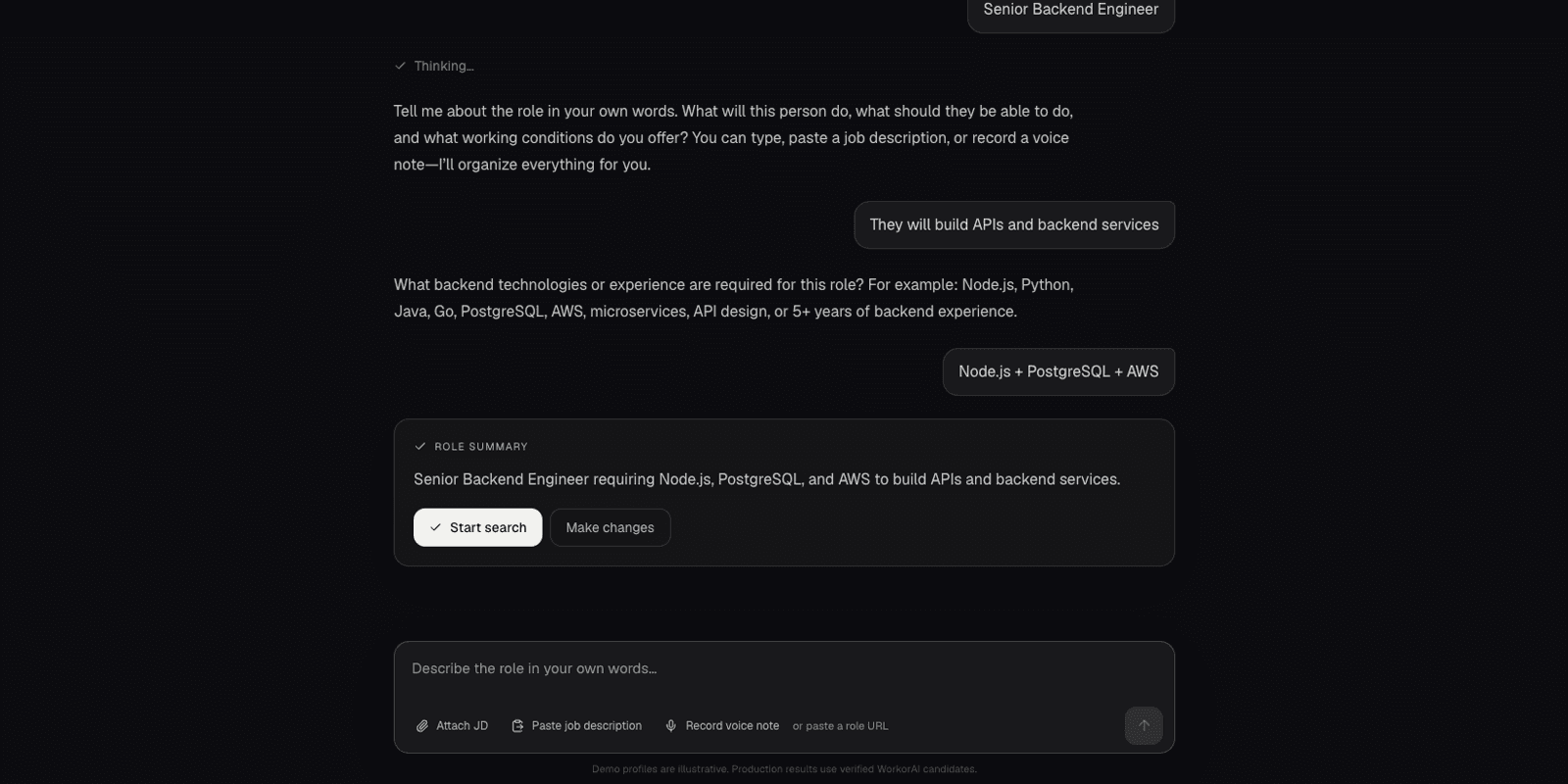
Step 1: turn the hiring request into an editable role brief
The first input is often too broad:
We need a senior backend engineer.
Before searching, the agent should ask what the person must accomplish and under which constraints. A useful brief might become:
- own Python services and PostgreSQL workloads in production;
- make reliability and observability decisions in a small team;
- work directly with product leadership as requirements change;
- overlap with European working hours;
- fit the approved compensation range;
- be available within the required window.
The criteria should separate three kinds of information:
| Type | Meaning | Example |
|---|
| Must-have | The role is not workable without it | Proven production backend ownership |
| Preference | Valuable, but negotiable | Experience in an early-stage AI company |
| Interview question | Important evidence is incomplete | Depth of mentoring and technical leadership |
This separation prevents a preference from quietly becoming a rejection rule. It also gives the hiring manager something concrete to correct before the system evaluates anyone.
WorkorAI summarizes the role criteria so the hiring manager can correct them before search begins. The screenshot uses illustrative demo data.
Step 2: search broadly enough to discover relevant engineers
Once the brief is clear, the agent can search the sources available to it. Discovery may use professional profiles, applications, internal talent records, portfolios, public work, referrals, or candidate-provided information.
The purpose is not to collect the largest possible database. It is to identify people who plausibly meet the role criteria and preserve the source behind each signal.
Search should also avoid treating exact keywords as proof. An engineer can have deep Kafka experience without listing the word in every role. Another person can list Kafka after limited exposure. The term helps find both profiles; evidence must distinguish them.
This is why an AI recruiting agent should model related capabilities and project context while keeping the original information visible. Semantic expansion can improve recall, but the hiring team must be able to see when a match is direct and when it is inferred.
The product makes the search stages visible instead of reducing the process to a loading spinner. The screenshot uses illustrative demo data.
Step 3: organize evidence instead of polishing profiles
Resume presentation has become cheap to improve. As explained in The resume is becoming a terrible hiring signal, a polished document can identify claims worth checking, but it should not be treated as proof by itself.
For each candidate, the agent should organize evidence across the dimensions that matter for the role:
| Dimension | Useful evidence | What it cannot prove alone |
|---|
| Technical capability | Relevant systems, project details, code or work samples where appropriate, structured technical discussion | Overall performance in every environment |
| Ownership | Decisions made, incidents handled, trade-offs explained, outcomes influenced | That every team result belonged to one person |
| Project context | Company stage, team shape, scale, constraints, product responsibility | Automatic transfer to a different context |
| Practical fit | Confirmed compensation, timezone, location or authorization where relevant, availability | Long-term motivation or performance |
| Candidate intent | Confirmed interest, priorities, concerns, preferred work | Final acceptance before both sides complete the process |
Each conclusion should be labeled as one of the following:
- observed: supported by direct work evidence;
- candidate-reported: stated by the candidate but not independently confirmed;
- inferred: estimated from related information;
- confirmed: explicitly verified for the current opportunity;
- unknown: not enough information yet.
An unknown is not automatically a negative. It is a guardrail against false certainty and often becomes an interview question.
Step 4: verify the constraints that can invalidate a match
Technical relevance is wasted if the working relationship cannot happen.
Before recommending an interview, an agent can help confirm:
- compensation expectations;
- timezone and required overlap;
- location or work authorization when the role requires it;
- availability or notice period;
- preferred employment arrangement;
- interest in the company, problem, and role.
These facts change and should carry a date. A compensation expectation from months ago or an old “open to work” signal should not be presented as current confirmation.
Verification also needs precise language. “Profile located in Berlin” is not the same as “candidate confirmed CET availability.” “Repository includes Go” is not the same as “candidate owned a production Go service.” The system should preserve that distinction.
Step 5: rank candidates with explanations
A hiring manager does not need another list of 100 possible profiles. The useful product is a small shortlist that explains why human attention should go to these people first.
For every recommendation, the agent should answer:
- Why is this candidate relevant to this role?
- Which evidence supports the recommendation?
- What is missing, uncertain, or potentially misaligned?
- What should the interview validate?
A decision-ready recommendation could look like this:
Recommendation: worth a technical interview

Why this person
- Owned Python APIs and PostgreSQL workloads in a comparable team
- Demonstrated relevant reliability and incident-response judgment
- Confirmed timezone, compensation range, availability, and interest

Evidence
- Explained specific architecture decisions and production trade-offs
- Work history supports the required scope
- Candidate-provided technical discussion is consistent with the role

Uncertain
- Limited evidence of mentoring at the level the role may require

Validate next
- Ask for a concrete example of improving another engineer's decisions
- Test architecture judgment for the first system they would own
The recommendation is not a hiring verdict. It is an explanation of why an interview is a reasonable next investment.
A shortlist connects the recommendation to evidence, practical constraints, and the next action. Candidate profiles shown here are illustrative demo data.
This is the same distinction explored in Don’t give me more candidates. Tell me who is worth interviewing.: a shortlist becomes useful when it reduces uncertainty rather than merely reducing the number of names.
Step 6: use manager feedback as calibration, not hidden model behavior
Suppose the agent ranks candidate A ahead of candidate B. The CTO says B should be first because experience with regulated data is essential.
A good system should not silently absorb the feedback. It should show:
- which criterion changed;
- whether it became a must-have or a preference;
- what evidence supports the new ranking;
- which other candidates moved as a result.
This turns disagreement into better hiring criteria. It also makes it easier to detect preferences that are unrelated to the work.
Explainability matters here because a percentage alone cannot support calibration. A score can summarize a recommendation, but the criteria, evidence, confidence, and trade-offs must remain inspectable.
Step 7: prepare a mutual introduction and focused interview
An introduction is more useful when both sides understand why the conversation may be relevant.
The employer should receive the evidence, open questions, and practical confirmations. The candidate should receive an honest description of the work, team, constraints, and reasons for the match. The agent can support scheduling and context transfer, but it should not invent enthusiasm or imply acceptance that neither side has expressed.
The interview can then focus on remaining uncertainty instead of repeating the resume:
- examine one architecture decision relevant to the role;
- test the scope of personal ownership;
- explore a trade-off or production incident;
- validate a capability that lacks direct evidence;
- discuss mutual expectations and working conditions.
Structured interviews are useful here because candidates are evaluated against job-related criteria with a consistent method. The questions do not have to be identical in every detail, but the underlying dimensions should be comparable.
AI hiring agent vs. other recruiting tools
| Tool | Primary strength | Work that usually remains |
|---|
| Job board | Generates inbound applicants | Screening, evidence review, practical verification |
| Candidate database | Provides searchable access to profiles | Role-specific evaluation and candidate interest |
| AI candidate search | Speeds discovery and recommendations | Evidence interpretation, uncertainty, interview planning |
| Technical assessment | Adds a defined technical signal | Context, ownership, motivation, constraints, introduction |
| Applicant tracking system | Organizes pipeline records and workflow | Finding and qualifying candidates |
| Recruiting agency | Adds human reach and judgment | Transparency varies by process and provider |
| AI hiring agent | Connects criteria, discovery, evidence, verification, ranking, and introduction | Human calibration, interviews, candidate care, final decision |
The categories can overlap. A hiring agent may connect with a search product, assessment, or ATS rather than replace it. The important question is not what the vendor calls the tool. It is which part of the decision the system actually prepares.
What an AI hiring agent should not do
The system should not:
- make an unreviewed employment decision;
- present inference as verified fact;
- hide the source or criteria behind a recommendation;
- use protected characteristics as shortcuts for job fit;
- treat missing public data as evidence of low ability;
- invent candidate interest, availability, or compensation;
- turn a universal match score into a claim of employability;
- keep learning from feedback without showing what changed.
NIST describes its AI Risk Management Framework as a voluntary framework for incorporating trustworthiness considerations into the design, use, and evaluation of AI systems. In hiring, practical application includes documented criteria, traceable evidence, human oversight, and ways to challenge or correct system output.
When an AI hiring agent is a good fit
It is especially useful when:
- founders or technical leaders are acting as the first resume filter;
- the role is specific enough to define meaningful evidence;
- qualified candidates may not be actively applying;
- interview time is expensive;
- practical constraints need early confirmation;
- the team wants to understand why candidates are recommended.
It is a weaker fit when the role is still undefined, stakeholders cannot agree on what success means, or nobody owns the final hiring decision. An agent can expose ambiguity. It cannot resolve organizational indecision by itself.
How to evaluate an AI recruiting agent
Before adopting one, ask for a concrete walkthrough:
- Can we edit the criteria before and after search?
- Does the system separate must-haves from preferences?
- Which sources does it use, and are sources visible?
- Does it distinguish observed, reported, inferred, and confirmed information?
- How does it handle candidates with little public work?
- Are practical constraints and interest checked directly?
- Can we see why one candidate ranks above another?
- Does manager feedback change the model visibly?
- What information is sent to the candidate?
- Who makes and records the interview and hiring decision?
The answer should be demonstrated on a realistic role, not only described in a product deck.
FAQ
What is an AI hiring agent for software engineers?
It is a system that helps move an engineering hiring need through criteria definition, candidate discovery, evidence organization, practical verification, explained ranking, and introduction. Its purpose is to prepare better-informed human decisions.
Is an AI hiring agent the same as candidate search?
No. Candidate search identifies possible matches. A hiring agent continues by evaluating role-specific evidence, identifying uncertainty, confirming current constraints and interest, and preparing the next step.
Can AI verify a software engineer?
AI can organize and compare evidence from available sources, but no single automated check proves overall engineering ability. Verification should be specific about what was checked, what the evidence supports, and what remains unknown.
Does an AI hiring agent replace a recruiter?
It can handle parts of sourcing, screening, evidence gathering, coordination, and documentation. People remain responsible for role calibration, candidate communication, interviews, exceptions, and the final decision.
What should an employer provide first?
A useful starting point includes the outcomes the engineer must own, required technical depth, team and product context, compensation range, timezone needs, employment constraints, and examples of strong or weak fit.
Should hiring teams trust an AI match score?
Not by itself. The team should inspect the criteria, sources, evidence, uncertainty, and trade-offs behind the score. A recommendation should be challengeable.
The real product is a better decision
The promise of an AI hiring agent is not unlimited candidate volume. It is less time spent converting scattered profiles into a defensible interview list.
The system has done useful work when a hiring manager can see:
- why each engineer is being recommended;
- which evidence supports that view;
- what remains uncertain;
- whether practical constraints and interest align;
- what the interview should validate.
That is how AI can make engineering recruiting more useful without pretending that a model should make the hiring decision.
Tell WorkorAI who you need—or what you are building. Review the evidence, gaps, and risks before deciding whom to interview.
Describe the engineer you need
Sources
- LinkedIn Recruiter features, accessed 2026-08-25. Used for current market context on AI-assisted search, candidate recommendations, messaging, pipeline management, and reporting.
- NIST AI Risk Management Framework, accessed 2026-08-25. Used for trustworthiness, risk management, and human-oversight principles.
- U.S. Office of Personnel Management: Structured Interviews, accessed 2026-08-25. Used for job-related and consistent interview criteria.
- WorkorAI for employers, accessed 2026-08-25. Used for product positioning and the employer CTA.