Ai security and hiring trust from day one now
As AI recruiting becomes the operating system beneath modern tech hiring, the question isn’t just whether platforms can match talent effectively—it’s whether the entire process feels trustworthy, secure, and transparent to those whose futures are at stake. Teams share their most sensitive knowledge, developers reveal their ambitions and salary ceilings, and businesses stake growth on candidate fit. Amid this high-stakes exchange, can traditional promises of “privacy” and generalized T&Cs truly convince rational skeptics—or does real adoption depend on deeper, infrastructural trust built from day one?
It’s time to move beyond the comforting glow of policy PDFs and start treating trust in AI hiring as a living product feature, not a late-stage compliance add-on. For founders and CTOs, this isn’t just the new hygiene—it’s the runway for differentiation, adoption, and the kind of talent partnerships that survive market storms. Understanding why—and how—these concepts move into the product core is now essential reading for every technical leader.
The Roots of Distrust in AI Recruiting Platforms
Why, despite years of digital transformation, does skepticism still shadow AI-driven hiring? For starters, developers and candidates willingly upload their work histories, preference stacks, and salary ranges, but have little insight into where (or how) personal data is stored, much less how it will be used when “evaluated” by opaque AI. When employers expect fair, unbiased matching, the result is often a black box—decisions explained with buzzwords, not evidence.
Legacy hiring platforms have historically relied on compliance-by-retrospect: publish a privacy page, draft reassuring but nebulous guidelines, and hope for the best. The implication is that trust can be established by corporate existence and fine print, not ongoing visibility. Yet, both individual contributors and the companies that hire them increasingly demand more—clarity not just in result, but in process and intent.
Trust as Product Infrastructure—Not a Checkbox
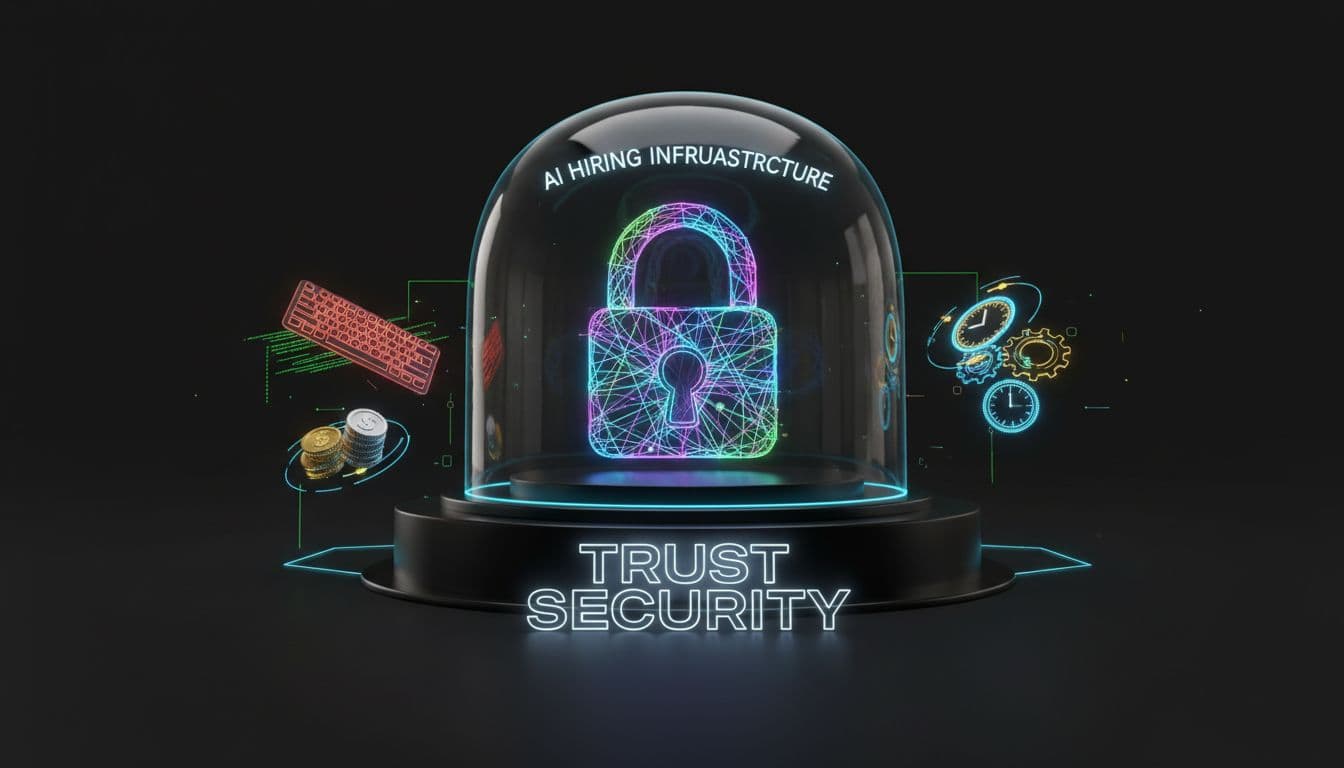
Trust in AI recruiting must evolve from a compliance checkbox to an infrastructural backbone—think encryption in digital banking: not marketed as a differentiator, but simply expected. When recruiting platforms treat candidate data and evaluation histories as live infrastructure, they move from abstract policy to daily operational reality.
WorkorAI exemplifies this shift—handling every WorkorAI Talent Profile as a securely stored, transparently processed entity, never an inert record on a server. Integration with the Model Context Protocol (MCP) means every access, whether from external AI agents or internal workflows, is brokered through a tightly regulated key system and explicit candidate consent. This is not privacy as a side dish; it’s the hull that keeps the operation afloat.
Core infrastructural elements include:
- Encrypted storage and end-to-end transmission for all profile and assessment data.
- Explicit, logged access via MCP keys, so every external AI interaction is visible, accountable, and revocable.
- Continuous threat modeling and real-time explanations, so both candidates and companies see not just outcomes, but how and why decisions are made.
Building Trust into Every AI Interaction
Building trust in AI-driven hiring isn’t about hiding risk but exposing—and managing—it intelligently at every turn. Here’s how modern systems like WorkorAI turn security from an invisible promise to a visible process:
| Trust Dimension | WorkorAI Approach |
|---|
| Profile Transparency | Candidates see, edit, and approve shared data |
| AI Agent Access | All agents (e.g., Claude, Codex) use MCP with explicit keys |
| Fit & Risk Evaluation | The Career Agent explains match, flags risks, never autoforwards |
| Evidence of Security | Logs, dashboards, integration proofs—visible to all stakeholders |
Developers know that true security isn’t flashy—it simply works, and its absence is glaringly obvious. Integration logs, dashboards that show exactly which agents accessed data, and explainers for every match recommendation make trust a perpetual feature, not a seasonal pop-up. For practical guidance on crafting smarter job matches without security tradeoffs, see Active Search: AI Prompt for Smarter Job Matches.
From Feature to Differentiator—Trust as Adoption Driver
What do ambitious founders and discerning CTOs actually gain from baking trust into their AI recruiting process? For one: developer confidence, which is–let’s admit it–harder to fool than any procurement checklist. When AI-based platforms show not only strong matches but also let talent control personal data and access logs, skepticism gives way to collaboration.
Product trust shortens decision cycles and boosts candidate engagement, leading to measurable gains in time-to-hire and quality-of-fit—outcomes that push ROI past the pilot phase. Long-term, trusted platforms attract top-tier talent naturally: the best developers join the networks that respect their privacy and explain their logic. Curious how a verified digital profile dramatically reduces friction? Dive into One Verified Developer Profile Beats 10 Screening Calls.
Related Perspectives—Connecting Hiring Trust to AI Ecosystems
This trust-as-infrastructure mindset is not limited to WorkorAI alone. Any agentic assistant—be it Codex, Copilot, Gemini CLI, Claude, or next-gen solutions like Antigravity—will soon face the same expectation: infrastructural honesty and clarity. The protocols and designs that enforce this not only meet current standards, but future-proof their AI hiring status for the era of fully autonomous, interconnected workflows.
Platforms that treat hiring trust as a living component play well not just with today’s AI agents, but tomorrow’s as well, ensuring smooth handoffs and reliable collaboration across the entire digital talent ecosystem. To futureproof your pipeline and spot self-defeating friction points, review 5 Signs Your Talent Pipeline Blocks Top Hires Now.
FAQ
Why isn’t a privacy policy enough for hiring platforms that use AI?
Because a privacy policy is retrospective—a set of static promises. Trust in AI hiring requires visible, auditable controls and transparent handling of every candidate interaction, giving stakeholders real assurance at every stage.
How does the Model Context Protocol make WorkorAI more secure than classic job boards?
MCP enforces all access through unique, revocable keys and explicit user consent, ensuring that only authorized agents and processes can access candidate data, with every interaction logged for audit and review.
What’s the difference between data encryption at rest and “trust by design”?
Encryption at rest protects stored data from technical breaches. “Trust by design” builds transparency, consent, and continuous verification into every workflow, raising the bar far beyond technical compliance.
Can businesses verify security controls when integrating personal AI agents?
Yes—WorkorAI provides integration logs and dashboards so teams can see, in real time, which data an agent accessed (and why), creating operational trust instead of just marketing claims.
How does WorkorAI protect candidates from unauthorized job applications?
No agent can auto-apply on a developer’s behalf. All applications and match confirmations require candidate review and explicit greenlight, with detailed explanations from the Career Agent before anything is submitted.
Conclusion
In this era of agentic job search and ecosystem-integrated AI, trust is no longer a compliance afterthought—it’s the backbone of real adoption. Founders and CTOs who demand infrastructural trust—from explicit access protocols to transparent match processes—transform security into an adoption enabler and credibility flywheel. The next time you revisit your hiring tech stack, ask: does our system deliver trust as an integrated product, or merely as a promise buried in legalese?
Ready to build real trust in your hiring process?
Install the WorkorAI Career Agent in your AI workspace today, experience how infrastructural trust creates tangible value, and help set the new market standard for secure, developer-centric hiring. The future belongs to the teams—and the platforms—that treat trust not as a checkbox, but as code-in-production.