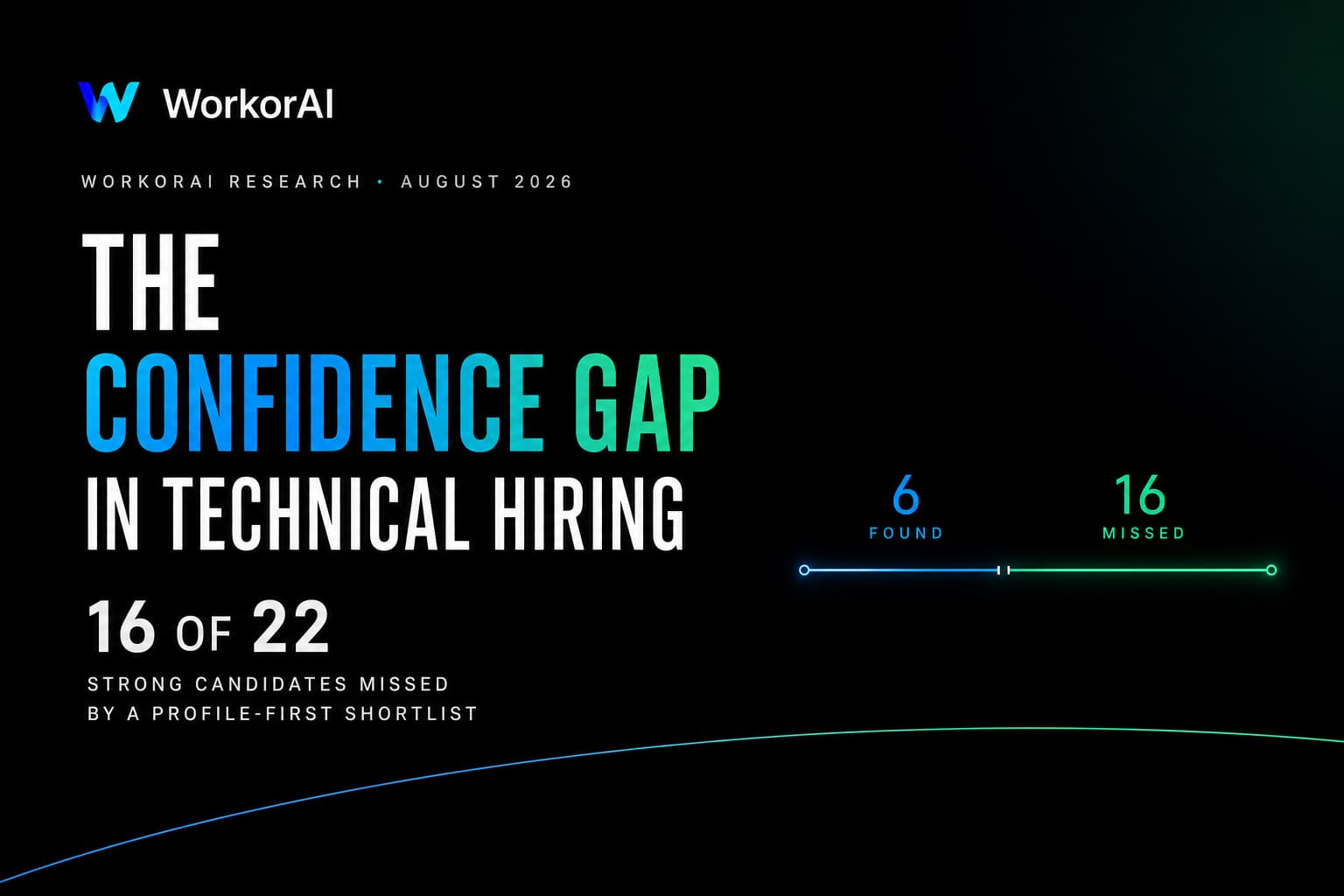
Answer: A software engineer is worth interviewing when role-specific evidence supports the capabilities the job requires, practical constraints are aligned, and the remaining uncertainty is narrow enough for an interview to resolve. A useful shortlist does not merely rank profiles. It explains why each person belongs on the list, what evidence supports that view, what remains uncertain, and what the interview should validate.
TL;DR
- Candidate volume is an input, not a hiring outcome.
- Define “worth interviewing” from the actual work, team, and constraints before searching.
- Evaluate technical evidence, ownership, project context, compensation, timezone, availability, and interest.
- Replace unexplained match scores with reasons, evidence, risks, and interview questions.
- AI can organize and compare evidence; accountable people should decide whom to interview and hire.
A list of candidates is not a hiring decision
A founder asks for a senior backend engineer. The recruiting system returns 147 profiles.
The search may have worked exactly as designed. The hiring problem is still sitting on the founder's desk.
Someone now has to determine which candidates have relevant production depth, which ones actually owned the work described, who can operate in the company's environment, whose compensation and timezone align, and who is interested in this particular role.
Until those questions are answered, the company does not have a shortlist. It has search results.
This distinction matters because the expensive part of engineering hiring is not displaying another profile. It is deciding where to spend human attention. A CTO reviewing resumes, a senior engineer joining a screening call, and a founder trying to interpret conflicting interview feedback are all paying for unresolved uncertainty.
The useful output is not:
Here are more people who might match.
It is:
Here are the engineers I would interview first, why they are ahead of the alternatives, and what still needs to be checked.
More candidates can create more work without creating more confidence
A larger pool can be valuable when a role is unusually narrow or the initial search is weak. But volume does not automatically improve the decision.
It can also introduce three problems.
The criteria become less consistent
After reviewing dozens of profiles, hiring teams often begin reacting to whatever appears in front of them. A familiar employer, an exact job title, or a polished resume quietly becomes more important than the criteria defined at the start.
Weak proxies receive too much weight
Keyword overlap is easy to compare. Production ownership, architecture judgment, incident responsibility, and the ability to work through ambiguity are harder. When screening must happen quickly, the easy fields tend to dominate.
Human attention moves to the wrong stage
Technical leaders spend time deciding whether a profile deserves a conversation instead of using their time to evaluate the most important open questions with credible candidates.
AI-written resumes make this weakness more visible because presentation is now inexpensive to improve. As discussed in The resume is becoming a terrible hiring signal, the document can help locate claims worth investigating, but it should not be treated as proof.
Define “worth interviewing” before searching
The standard must come from the role, not from the available candidates.
“Senior Python engineer” is not enough. A useful hiring brief might say:
- own production APIs and data workflows with a small team;
- make reliability and observability decisions without a platform department;
- work through changing product requirements with a founder;
- overlap with European working hours;
- fit the approved compensation range;
- be interested in joining an early-stage AI product company.
Now the hiring team can ask what evidence would support each requirement.
For production ownership, useful evidence may include specific design decisions, incidents, trade-offs, and outcomes. For startup fit, it may include examples of working with incomplete information and limited resources. For practical fit, it requires confirmed compensation, timezone, availability, and interest—not inference from a location or job title.
The standard should also distinguish:
- must-haves: missing them makes the role unworkable;
- preferences: relevant but negotiable advantages;
- interview questions: important areas where pre-interview evidence is incomplete.
This prevents every gap from becoming a rejection and every matching keyword from becoming a reason to interview.
What evidence should exist before an interview?
The answer depends on the role, but a decision-ready review usually covers five dimensions.
| Dimension | Question | Useful pre-interview evidence | Common mistake |
|---|
| Technical capability | Can this person do the required work? | Relevant systems, project details, code or work evidence where appropriate, structured technical discussion | Treating a technology keyword as depth |
| Ownership and seniority | Can they handle the expected scope? | Decisions made, ambiguity handled, incidents owned, influence on teammates and outcomes | Treating years or title as a complete seniority measure |
| Project context | Is their experience relevant here? | Company stage, team shape, system constraints, product responsibility | Assuming a strong brand transfers automatically |
| Practical fit | Can the working relationship function? | Confirmed compensation, timezone, location or authorization where relevant, availability | Leaving constraints until late in the process |
| Candidate intent | Do they want to discuss this role? | Confirmed interest, motivations, concerns, preferred work | Confusing a discoverable profile with an interested candidate |
No single source can answer every question.
A public repository may provide direct technical evidence for one engineer and almost none for another whose work is private. A structured interview can test reasoning but cannot recreate years of production performance. Employment history gives context but does not establish individual ownership. Assessments can add evidence for defined capabilities but do not resolve motivation or practical fit.
The goal is not perfect certainty before the interview. It is enough credible, role-specific evidence to make the interview a reasonable next step.
A shortlist should explain four things
Putting five resumes into a smaller folder does not create a qualified shortlist.
Every recommendation should answer four questions.
Why should we interview this person?
Connect the recommendation to the actual role. “Strong engineer” is too broad. “Has owned Python services in a comparable team and demonstrated relevant reliability judgment” is more useful.
What evidence supports that view?
Attach the source behind each important conclusion. Mark whether it is observed, candidate-reported, inferred, or confirmed.
What should we be careful about?
Show missing evidence and trade-offs. A gap is not automatically a rejection. It is a warning against false confidence and a possible interview topic.
What should the interview validate?
Turn uncertainty into a focused plan. If mentoring scope is unclear, ask for a specific example. If Kubernetes appears on the resume but production ownership is uncertain, examine deployment decisions, failure modes, and incident responsibility.
This is more valuable than a percentage because the hiring manager can challenge the reasoning. The recommendation becomes something the team can calibrate instead of something it must trust.
Example: a decision-ready recommendation
Recommendation: Worth a technical interview

Why this person
- Owned Python APIs and PostgreSQL workloads at a comparable product stage
- Worked directly with product leadership in a small engineering team
- Compensation, timezone, and current interest are aligned

Evidence
- Described specific reliability decisions and a production incident
- Work history is consistent with the required scope
- Structured technical discussion supports backend depth

Uncertain
- Limited evidence of mentoring engineers at the level this role may require

Validate next
- Ask for a concrete example of improving another engineer's technical decisions
- Test architecture judgment for the first project they would own
The recommendation is not a hiring verdict. It is a justified use of interview time.
Ranking should make disagreement easier
Hiring managers will disagree with recommendations. That is useful when the disagreement improves the criteria.
If a CTO says candidate B should rank above candidate A because regulated-data experience is essential, the role model should change visibly. The system should show which candidates move and why.
If the preference is based on something unstated—such as familiarity with a particular employer—the process should expose that too. The team can then decide whether the preference is genuinely job-related.
An unexplained score cannot support this conversation. A score can summarize a recommendation, but the criteria, evidence, confidence, and trade-offs must remain inspectable.
Candidate comparison should expose evidence and trade-offs—not ask the hiring manager to trust one overall score. The profiles shown here are illustrative demo data.
What an AI hiring agent should do
An AI hiring agent can reduce the work between a hiring need and a credible interview list.
| Stage | Agent responsibility | Output for the hiring team |
|---|
| Understand | Convert the need into editable outcomes, requirements, and constraints | Role criteria the manager can correct |
| Search | Find potentially relevant engineers across available sources | Candidate set with source context |
| Evaluate | Compare each person with the same role-specific criteria | Evidence-backed fit analysis |
| Verify | Confirm practical constraints, interest, and available technical evidence | Facts, inference, and missing information |
| Rank | Prioritize candidates without hiding trade-offs | Explained shortlist |
| Prepare | Convert remaining uncertainty into interview questions | Focused interview plan |
| Introduce | Help both sides move into a relevant conversation | Interview-ready handoff |
The agent should not silently decide who is employable or who deserves a job. It should make evidence easier to gather, compare, and challenge while keeping the hiring team accountable for interviews, candidate treatment, and the final decision.
A practical test for your next shortlist
Before sending a shortlist to a founder, CTO, or hiring manager, check whether it answers:
- What must this engineer accomplish in the role?
- Why is each person on the list?
- Which evidence supports the recommendation?
- Which statements are confirmed, inferred, or self-reported?
- What important evidence is missing?
- Are compensation, timezone, availability, and interest aligned?
- Why is candidate A ahead of candidate B?
- What should the interview validate?
If the document only contains names, titles, resumes, and match percentages, it is still a search result.
FAQ
How many candidates should be on an engineering shortlist?
There is no universal number. The shortlist should be small enough for the hiring team to understand each recommendation and broad enough to preserve meaningful choice. Quality depends on evidence and role fit, not a fixed count.
What makes a software engineer qualified for an interview?
Relevant evidence should support the technical capability, ownership, and project context required by the role. Practical constraints and genuine interest should also align, while remaining uncertainties should be specific enough to test in the interview.
Is a match score useful for shortlisting candidates?
It can be a summary, but it should not replace the explanation. Hiring teams need to see the criteria, evidence, confidence, risks, and trade-offs behind the score.
Can AI decide which engineers to interview?
AI can recommend and explain based on job-related criteria. Accountable people should review those recommendations, correct incomplete information, monitor outcomes, and make the interview and hiring decisions.
How is an AI hiring agent different from candidate search?
Search returns possible candidates. A hiring agent continues through evaluation, evidence gathering, practical verification, ranking, explanation, and introduction.
Stop measuring the top of the funnel
The number of profiles found is not the result a hiring team needs.
The result is a small group of software engineers with enough relevant evidence to justify a focused conversation—and enough visible uncertainty for the interviewer to know what to test.
WorkorAI is the AI Hiring Agent for Software Engineers. Tell it who you need—or what you are building—and review the evidence, gaps and risks before deciding whom to meet and hire.
Describe who you need
Sources